Show a child one picture of an okapi and they will recognize okapis for the rest of their life. Show a conventionally trained neural network one picture and it has learned almost nothing, because ordinary supervised-learning treats every new task as a fresh start requiring thousands of labeled examples. Meta-learning closes that gap by moving the learning up a level: instead of learning one task from many examples, the system learns across many tasks how to learn, so that the next task takes only a few examples.
The idea
Treat entire tasks the way ordinary training treats examples. Over many learning episodes, improve the learning algorithm itself (its comparisons, its memory, or its starting point) so that adaptation to a new task becomes fast and data-cheap. The literature calls this “learning to learn.”
Why one level up
Every learning algorithm carries an inductive bias, a set of built-in assumptions about the data, and no single bias works well everywhere. Ordinary training fixes the algorithm and fits the data. Meta-learning instead uses experience from many learning episodes to improve the algorithm, a framing the Hospedales et al. survey (2020) uses to distinguish it from solving each task from scratch with a hand-designed learner. The payoff shows up exactly where deep learning is weakest: settings with a data bottleneck, where a big net would simply memorize its handful of examples (the same failure mode that regularization-in-deep-learning fights within a single task).
Few-shot learning, the benchmark setting
The standard proving ground is few-shot classification: learn a task from only a small number of labeled examples per class. Benchmarks phrase it as N-way K-shot, distinguish among N classes given K labeled examples of each. One-shot learning is the special case K = 1, generalizing from exactly one example per class, and zero-shot learning is the limiting case where the target class has no examples at all and the task must be generalized from other classes.
A meta-learner is trained on a stream of small tasks of this shape (different classes each time) and evaluated on its ability to handle a task built from classes it has never seen.
Three families of approach
The field sorts roughly into three strategies, differing in what gets learned at the meta level:
Metric-based methods learn an embedding space and a comparison function, then classify new examples by similarity to the few labeled ones, in the spirit of nearest neighbors. Siamese networks, matching networks, and prototypical networks (which compare against a learned prototype per class) are the canonical examples.
Model-based methods build fast adaptation into the architecture itself, typically through some form of internal or external memory. Memory-augmented neural networks are the representative case: the network’s stored state, not gradient updates, carries the new task.
Optimization-based methods keep ordinary gradient training but learn a better optimization process or starting point, so that a few gradient steps suffice. MAML and its relatives (Reptile, the LSTM meta-learner) live here.
MAML: learn an initialization worth fine-tuning
Model-Agnostic Meta-Learning (Finn, Abbeel, and Levine, 2017) is the cleanest expression of the optimization-based idea. “Model-agnostic” means it assumes nothing about the architecture beyond one thing: the model is trained with gradient-descent. That makes it applicable to essentially any modern network, including any artificial neural network you would train normally.
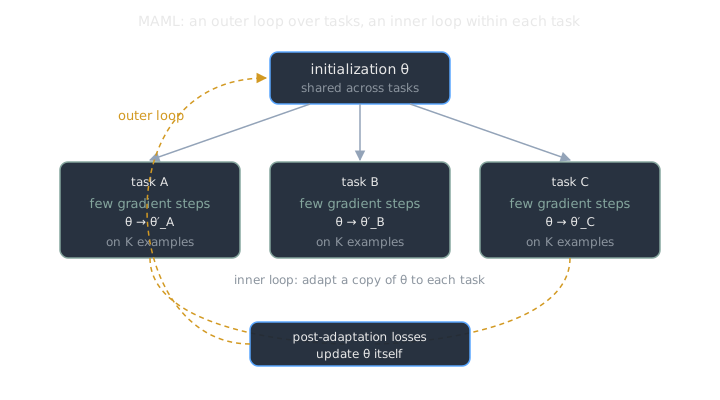
The mechanism is two nested loops. The inner loop takes the current shared parameters and adapts a copy to one specific task using a small number of gradient steps on a small amount of that task’s data. The outer loop then asks the meta-question: after that cheap adaptation, how well did the adapted model do? It updates itself to make the answer better next time. Nothing about the trained model is exotic; what is special is where it starts. MAML deliberately optimizes for maximal sensitivity to fine-tuning, an initialization from which a few steps in any task’s direction go a long way.
Finn et al. demonstrated the recipe on few-shot image classification (where it was state-of-the-art on standard benchmarks at publication), few-shot regression, and reinforcement learning with neural network policies, which is a strong argument that the idea really is model-agnostic.
Example
A 5-way 1-shot episode: hand the meta-trained model one labeled photo each of five animal species it has never seen, let it take a few gradient steps on those five images, then ask it to classify new photos of those species. A network trained from scratch on five images would be hopeless. A MAML-trained network can do this because thousands of earlier episodes shaped its initialization for exactly this kind of quick pivot.
Related Notes
- supervised-learning, the one-task-many-examples baseline meta-learning generalizes
- gradient-descent, the machinery MAML’s inner and outer loops both run on
- artificial-neural-networks, the models being meta-trained
- regularization-in-deep-learning, the within-task answer to scarce data; meta-learning is the across-task answer
- ai-vs-ml-vs-dl, where all of this sits in the wider field
Sources
- Finn, Abbeel, Levine, “Model-Agnostic Meta-Learning for Fast Adaptation of Deep Networks,” ICML 2017: https://arxiv.org/abs/1703.03400
- Hospedales, Antoniou, Micaelli, Storkey, “Meta-Learning in Neural Networks: A Survey,” 2020: https://arxiv.org/abs/2004.05439
- Wikipedia, “Meta-learning (computer science)”: https://en.wikipedia.org/wiki/Meta-learning_%28computer_science%29
- Wikipedia, “Few-shot learning”: https://en.wikipedia.org/wiki/Few-shot_learning