Overview
A disjoint set (Union–Find) maintains a partition of elements into disjoint components under two operations: FIND(x) returns the component’s representative (root) of x, and UNION(x,y) merges the components containing x and y. With path compression (during FIND) and union by rank/size, both operations run in amortized almost-constant time: , where is the inverse Ackermann function.
Structure Definition
- Universe: elements indexed
0..n-1. - Arrays:
parent[i]: parent pointer; roots satisfyparent[i] = i.rank[i]orsize[i]: tie-breaker for unions (rank ≈ upper bound on tree height).
- Invariants: Each set is a rooted tree; paths follow
parentpointers up to a root (the representative).
Core Operations
Make-set
function MAKE_SET(n):
    for i in 0..n-1:
        parent[i] = i
        rank[i] = 0        // or size[i] = 1
Find with path compression
function FIND(x):
    if parent[x] != x:
        parent[x] = FIND(parent[x])   // path compression
    return parent[x]
Union by rank (or by size)
function UNION(x, y):
    rx = FIND(x)
    ry = FIND(y)
    if rx == ry: return rx            // already same set
    // attach smaller-rank tree under larger-rank tree
    if rank[rx] < rank[ry]:
        parent[rx] = ry
        return ry
    else if rank[rx] > rank[ry]:
        parent[ry] = rx
        return rx
    else:
        parent[ry] = rx
        rank[rx] = rank[rx] + 1
        return rx
Tip
Rank vs size. Either works. Rank is a theoretical height bound; size is often simpler and competitive in practice (attach smaller to larger).
Example (Stepwise)
Start with elements {0,1,2,3,4,5} as singletons.
-
UNION(0,1)→ root0with rank 1; sets:{0,1},{2},{3},{4},{5}. -
UNION(2,3)→ root2; sets:{0,1},{2,3},{4},{5}. -
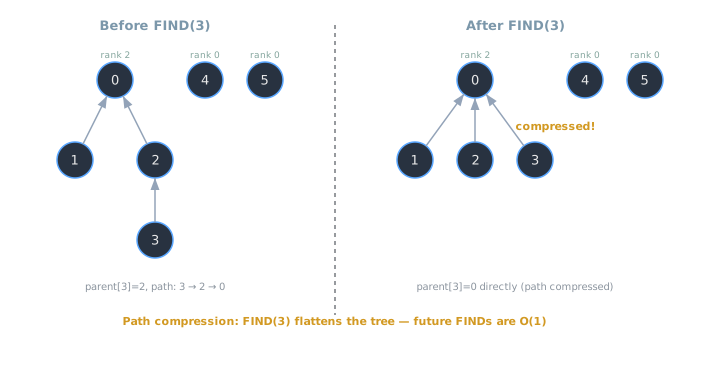
UNION(1,3)→ findsFIND(1)=0,FIND(3)=2; ranks equal → attach2under0, incrementrank[0]; sets:{0,1,2,3},{4},{5}. -
FIND(3)after prior unions compresses path soparent[3]=0directly.
Complexity and Performance
-
Time (amortized): With path compression + union by rank/size, any sequence of
poperations onnelements runs in , which is effectively constant per operation for all practical input sizes. -
Space:
O(n)forparentplusrank/size.
Why it’s fast. Path compression flattens find-paths aggressively; union by rank/size prevents tall trees from forming. Together, they limit future costs to the tiny inverse Ackermann factor.
Implementation Details or Trade-offs
-
Path compression variants:
-
Full compression (as above) sets every node on the path directly to the root.
-
Path halving / path splitting adjust every other node; often faster in tight loops due to fewer recursive calls.
-
-
Iterative find: Re-implement
FINDiteratively to avoid recursion limits; second pass compresses parents to the root. -
ID mapping: If elements aren’t dense integers, map them to
0..n-1with a dictionary; store original IDs separately. -
Threading: Naïve Union–Find isn’t thread-safe; for parallel Kruskal use coarse-grained locks per root or batched unions (specialized algorithms exist).
Practical Use Cases
-
Dynamic connectivity: Maintain connectivity as edges are added in an undirected graph.
-
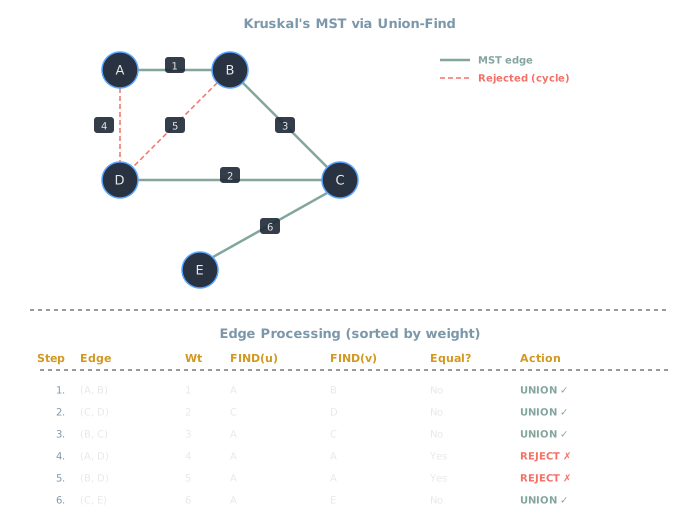
Minimum spanning tree: Kruskal’s algorithm repeatedly unions endpoints of chosen edges. See Kruskal’s Algorithm and Minimum Spanning Trees: Kruskal & Prim.
-
Clustering & segmentation: Merge by similarity thresholds (e.g., image components).
-
Equivalence closure: Merge constraints expressing “must be equal.”
Limitations / Pitfalls
Warning
Forgetting compression. Union by rank/size alone can still leave long paths after many finds; always combine with path compression.
Warning
Rank updates. Only increase rank when two equal-rank roots are united; otherwise rank is unchanged. Incorrect rank bumps degrade performance.
Warning
Directed graphs. Union–Find models undirected connectivity; for directed reachability, use graph algorithms (e.g., DFS/BFS, SCC).
Summary
Union–Find represents components as parent-pointer forests and achieves near-constant amortized time for connectivity queries by combining path compression with union by rank/size. It is the standard backbone for dynamic connectivity and MST algorithms due to its simplicity, speed, and small memory footprint.