For most of computing history, to run programs at scale you bought and racked the machines. Cloud computing replaced that with something stranger: rent exactly the computing you need, by the hour, from a pool you never see. The idea that makes it possible is virtualization.
The idea
Virtualization. A hypervisor multiplexes one physical machine into many isolated virtual machines, so computing can be sliced, rented, and scaled on demand instead of bought and owned.
On demand and metered
Cloud computing provides a scalable, elastic pool of computing resources with self-service provisioning on demand. Providers typically bill on a utility basis, where the cost reflects the resources allocated and consumed. You pay for what you use, the way you pay for electricity, rather than buying a power plant.
The hypervisor
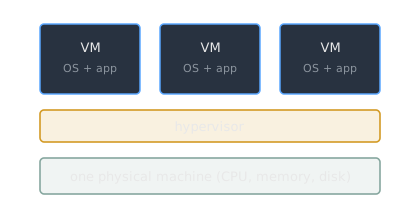
A hypervisor runs virtual machines as guests, and pools of hypervisors support large numbers of virtual machines that scale up and down with demand. This is the layer that decouples computation from any one physical box: a virtual machine can be created, moved, and destroyed in seconds, on hardware its user never touches.
The commercial turn
In 2006 Amazon released S3 for storage and EC2 for compute, letting developers build applications on rented infrastructure with no servers of their own. That moment turned virtualization from a data-center technique into the defining infrastructure of the modern era, the substrate under a large fraction of the internet you use every day.
Related Notes
- Distributed Consensus, keeping many cloud machines agreed
- Virtual Memory, an older virtualization of one resource
- Network Protocols, how cloud services are reached
- History of the Internet, the network cloud runs over
- History of Computing, the section index
Sources
- “Cloud computing,” Wikipedia. https://en.wikipedia.org/wiki/Cloud_computing . Supports cloud computing as on-demand, self-service, elastic resources billed on a utility basis, the hypervisor running virtual machines as guests with pools that scale, and Amazon’s 2006 release of S3 and EC2 as an early commercial cloud.