In December 1947, three physicists at Bell Labs made a sliver of germanium amplify a signal, and the direction of electronics changed. The transistor would replace the vacuum tube and become the physical atom of all digital computing.
The idea
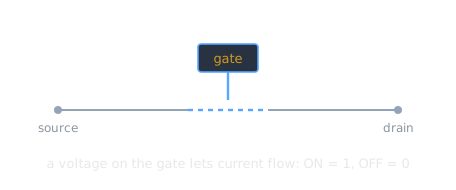
A transistor is a tiny solid-state switch, and amplifier. A small signal on one terminal controls a larger current through the others, so a single transistor can hold or pass a bit. Wire enough of them together and you have logic.
The invention
John Bardeen and Walter Brattain, working under William Shockley at Bell Labs, observed transistor action between 17 November and 23 December 1947; the three shared the 1956 Nobel Prize in Physics. A transistor is a semiconductor device that amplifies or switches electrical signals, and it is now considered one of the twentieth century’s greatest inventions.
Why it beat the tube
Compared with the vacuum tube, transistors are smaller, cheaper, and need far less power, and they do not burn out the way a heated filament does. The tube-based machines that needed heroic redundancy just to stay running gave way to solid-state reliability, and computers began their long shrink from buildings to pockets.
The building block
The transistor is the key active component in practically all modern electronics. Everything above it is built from transistors acting as switches: the logic gates that Shannon showed how to design, and from those gates, processors and memory.
Related Notes
- The MOSFET, the transistor design that made chips buildable
- The Integrated Circuit, many transistors on one chip
- Shannon’s Master’s Thesis, switches as logic
- The AN/FSQ-7, the tube era the transistor ended
- History of Computing, the section index
Sources
- “Transistor,” Wikipedia. https://en.wikipedia.org/wiki/Transistor . Supports the 1947 invention at Bell Labs by Bardeen and Brattain under Shockley, the transistor as a semiconductor device that amplifies or switches signals, its advantages over the vacuum tube (smaller, less power), and its role as a basic building block of modern electronics.