Intuition
Unix is more than an operating system; it is a design philosophy that shaped how we think about software. The core idea is radical simplicity: build small programs that each do one thing well, connect them with text streams, and let the user compose complex behavior from simple parts. This philosophy, born at Bell Labs in 1969, led directly to C, influenced every major OS that followed, and seeded the open-source movement that now powers most of the internet’s infrastructure.
If modern software development has a cultural origin story, it runs through Unix. The terminal you open, the pipes you chain, the package manager you invoke - all trace back to decisions made by Ken Thompson, Dennis Ritchie, and their colleagues over fifty years ago.
Core Idea
Origins at Bell Labs (1969–1973)
After Bell Labs withdrew from the Multics project (an ambitious but overengineered time-sharing system), Ken Thompson and Dennis Ritchie built a stripped-down alternative on a spare PDP-7:
- 1969: Thompson wrote the first Unix in assembly - a single-user system with a file system, a shell, and a few utilities.
- 1970–1971: Unix was officially named and ran on the PDP-11; the First Edition “Unix Programmer’s Manual” followed in 1971.
- 1973: Ritchie rewrote Unix in C, a language he designed specifically for systems programming. This made Unix portable - it could be recompiled for different hardware, an unprecedented capability for an OS.
The decision to write an OS in a high-level language was revolutionary. It tied Unix’s fate to C and gave both enormous momentum.
The Unix Philosophy
Doug McIlroy, the inventor of Unix pipes, summarized the philosophy:
Write programs that do one thing and do it well. Write programs to work together. Write programs to handle text streams, because that is a universal interface.
Key principles:
- Small, composable tools:
grep,sort,awk,sed- each does one job. Pipes (|) connect them. - Everything is a file: Devices, sockets, and processes are accessed through the same file interface.
- Text as universal interface: Programs communicate via plain text streams, enabling ad-hoc composition.
- Worse is better: A simple, slightly incomplete solution that ships beats a complex, perfect solution that doesn’t. (Richard Gabriel’s formulation, reflecting Unix culture.)
C and Unix: A Symbiosis
C was not designed in isolation - it was designed for Unix, and Unix was rewritten in C. This symbiosis means:
- C’s memory model (pointers, manual allocation) maps directly to hardware, which is what an OS kernel needs.
- C’s simplicity and portability made Unix portable.
- Unix’s success made C the dominant systems language for decades.
See Compilation vs Interpretation for how C’s compiled model contrasts with interpreted languages, and History & Genealogy of Languages for C’s influence on C++, Java, Go, and Rust.
The BSD Fork and the AT&T Split
In the late 1970s, UC Berkeley developed its own Unix variant - the Berkeley Software Distribution (BSD):
- Added virtual memory, the TCP/IP networking stack (which became the internet’s reference implementation), and the C shell.
- 1992–1994: Legal battles between AT&T’s Unix subsidiary and BSDi delayed BSD’s adoption, opening a window for Linux.
- BSD lives on today in FreeBSD, OpenBSD, NetBSD, and as the kernel underpinning macOS (Darwin/XNU).
GNU and Linux (1983–1991)
- 1983: Richard Stallman announced the GNU Project - a free (as in freedom) reimplementation of Unix. He wrote GCC, Emacs, and many core utilities but lacked a kernel.
- 1991: Linus Torvalds released the Linux kernel - a Unix-compatible kernel written from scratch. Combined with GNU userland tools, “GNU/Linux” became a complete free operating system.
- Linux was licensed under the GPL (GNU General Public License), which requires derivative works to remain open source - a “copyleft” license.
The Open-Source Movement
The term “open source” was coined in 1998 to make free software more palatable to business:
- Free Software Foundation (FSF): Stallman’s organization, emphasizing freedom (free as in speech, not beer). The GPL family of licenses.
- Open Source Initiative (OSI): Eric Raymond, Bruce Perens, and others reframed the argument around practical benefits - better code through transparency, community review, and shared maintenance.
- Key licenses: GPL (copyleft), MIT/BSD (permissive), Apache 2.0 (permissive with patent grants).
Today, open-source software runs most web servers (Linux, Nginx, Apache), most cloud infrastructure (Kubernetes, Docker), most mobile devices (Android’s Linux kernel), and most developer tools (Git, VS Code, GCC/LLVM).
Note
The distinction between “free software” and “open source” is philosophical, not technical. Both produce publicly available source code. They disagree on why - freedom vs. pragmatism.
Example
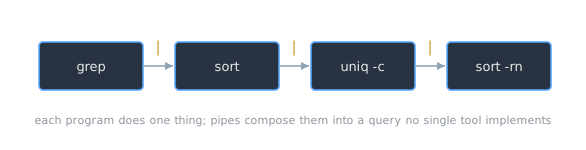
The Unix philosophy in action - a one-liner pipeline:
cat server.log | grep "ERROR" | awk '{print $1, $2}' | sort | uniq -c | sort -rn | head -10This pipeline:
catreads the log file.grepfilters to error lines.awkextracts the date and time fields.sortorders them alphabetically (needed foruniq).uniq -ccollapses duplicates and counts occurrences.sort -rnorders by count, descending.head -10shows the top 10 most frequent error timestamps.
Seven small programs, none of which knows about the others, composed via pipes to answer a specific question. No single monolithic tool needed. This is the Unix philosophy at work - and it is why Unix-descended systems dominate server infrastructure decades later.
Related Notes
- Compilation vs Interpretation - C’s compiled model and its role in Unix’s performance
- History & Genealogy of Languages - C’s descendants and Unix’s influence on language design
- Von Neumann Architecture - the hardware model Unix was built to manage
- Turing & Computability - the theoretical universality that makes portable OSes possible
- History of the Internet - BSD’s TCP/IP stack became the internet’s foundation
Sources
- “History of Unix,” Wikipedia. https://en.wikipedia.org/wiki/History_of_Unix . Supports Unix’s start at Bell Labs in 1969 after the withdrawal from Multics (Ken Thompson on a PDP-7), the move to the PDP-11 and the system being named around 1970, the 1973 rewrite in C (Version 4) that gave portability, the BSD networking releases, and the AT&T/BSDi copyright litigation of the early 1990s.
- “Unix philosophy,” Wikipedia. https://en.wikipedia.org/wiki/Unix_philosophy . Supports Doug McIlroy as inventor of the Unix pipe and source of the “do one thing well / work together / handle text streams” summary, and “worse is better” as Richard P. Gabriel’s phrase.
- “History of free and open-source software,” Wikipedia. https://en.wikipedia.org/wiki/History_of_free_and_open-source_software . Supports the 1983 launch of the GNU Project by Richard Stallman, the 1991 release of the Linux kernel by Linus Torvalds, the GPL as a copyleft license, and the 1998 coinage of “open source” and founding of the Open Source Initiative.