In the early 1950s, programming a computer meant writing numeric machine code by hand for one specific machine. Grace Hopper, a U.S. Navy officer who would retire a rear admiral, thought that had it backward. The machine was the thing that was good at tedious, error-prone translation, so the machine should do it. Acting on that conviction, she built some of the first tools that turned human-readable instructions into machine code, and pointed the way to the languages programmers use now.
The idea
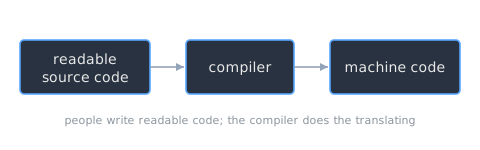
Compilation: people should write in a readable, machine-independent language, and a compiler should do the work of translating it into machine instructions.
A program that writes a program
By 1952 Hopper had finished the A-0 system, which she called a compiler. It took named routines and assembled and linked them into runnable machine code, so a programmer could call for a routine by name instead of copying its numbers by hand. The idea that a program could prepare another program for the machine was unfamiliar at the time, and it met resistance from people who assumed computers could only do arithmetic.
Toward English
Hopper pushed past assembling routines toward something a person could simply read. Her department produced FLOW-MATIC, one of the first languages built around English-like statements, so the text of a program described what it did in words rather than in codes.
The line to COBOL
FLOW-MATIC’s ideas carried directly into COBOL, the business-oriented language that came to run a large share of the world’s banking and administrative software, much of which still runs today. The thread from Hopper’s work to a running COBOL payroll system is direct.
What she actually changed
The durable idea is the one she started with: people should write in a readable, machine-independent language, and a compiler should turn that into instructions. Every high-level language since rests on it.
Related Notes
- History and Genealogy of Languages, where this fits in the family tree
- Compilation vs Interpretation, the mechanism Hopper helped invent
- Von Neumann Architecture, the machine the compiler targets
- Turing and Computability, the theory of what these machines can do
- Computing and the U.S. Military, the cluster index
Sources
- “Grace Hopper,” Wikipedia. https://en.wikipedia.org/wiki/Grace_Hopper . Supports her U.S. Navy service, the A-0 system finished by 1952 which she called a compiler, the development of FLOW-MATIC as an English-like language, and FLOW-MATIC’s influence on COBOL.