Overview
Subtyping adds hierarchy to type systems, enabling reuse and polymorphism.
When combined with generics or functions, however, it introduces variance problems, subtle but essential for type safety.
Note
Subtyping extends type systems horizontally (via relationships between types), while parametric polymorphism extends them vertically (via generic abstraction).
What Is Subtyping?
A type A is a subtype of B (A <: B) if every value of A can safely be used wherever a B is expected.
Formally:
A <: B ⇒ for all contexts C[•], if C[B] is valid, then C[A] is valid
This property is known as substitutability, the foundation of type-safe reuse.
Example:
class Animal {}
class Dog extends Animal {}

Animal a = new Dog();  // OK: Dog <: Animal
Tip
Subtyping ≠ inheritance, but many OO languages conflate the two.
In pure type theory, subtyping is a semantic relation, not a syntactic one.
The Subtyping Relation
Subtyping is reflexive and transitive:
A <: A
A <: B  and  B <: C  ⇒  A <: C
Languages extend this with additional rules for:
-
Function types
-
Product / record types
-
Union and intersection types
-
Generic type constructors
Function Types and Variance
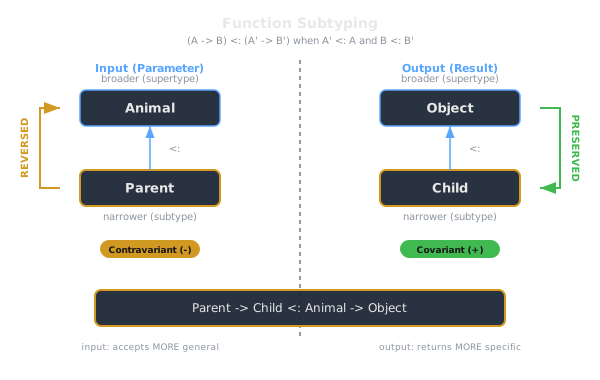
Functions flip the direction of subtyping on parameters.
(A → B) <: (A' → B') ⇔ A' <: A ∧ B <: B'
| Component | Direction | Intuition |
|---|---|---|
| Parameter (input) | Contravariant | Accepts more general arguments |
| Result (output) | Covariant | Returns more specific results |
Example (in type-lambda form):
Parent → Child <: Animal → Object
Because:
-
Animalis broader thanParent(contravariant on input), -
Childis narrower thanObject(covariant on output).
Variance of Type Constructors
When a type constructor F (like List or Box) wraps a type T, the question arises:
If
A <: B, does that implyF[A] <: F[B]?
Possible Answers
| Variance | Rule | Example | Safe For |
|---|---|---|---|
| Covariant | A <: B ⇒ F[A] <: F[B] | List[Dog] <: List[Animal] | Read-only containers |
| Contravariant | A <: B ⇒ F[B] <: F[A] | Comparator[Animal] <: Comparator[Dog] | Consumers (function arguments) |
| Invariant | Neither direction holds | Array[Dog] ≮: Array[Animal] | Mutable containers |
Warning
Covariance becomes unsafe when mutation is allowed: you could insert a
Catinto an array ofDog.
Example: Why Arrays Are Invariant
Java allows covariant arrays, but it’s unsound:
Animal[] animals = new Dog[1];
animals[0] = new Cat(); // Runtime ArrayStoreException
The type system lets it compile but must insert runtime checks to preserve safety.
Modern designs (like generics in Java or C#) default to invariance for mutable types.
Variance Ladder
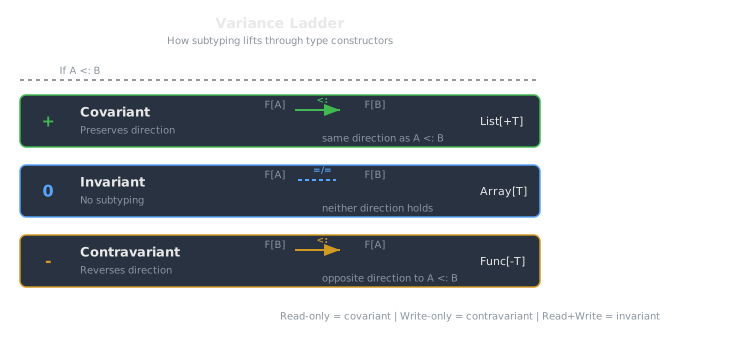
Covariance, invariance, and contravariance form a conceptual ladder of generality.
| Variance | Symbol | Meaning | Example |
|---|---|---|---|
| Covariant | + | Preserves subtyping | List[+T] |
| Invariant | 0 | No subtyping | Array[T] |
| Contravariant | - | Reverses subtyping | Func[-T] |
Bounded Type Parameters
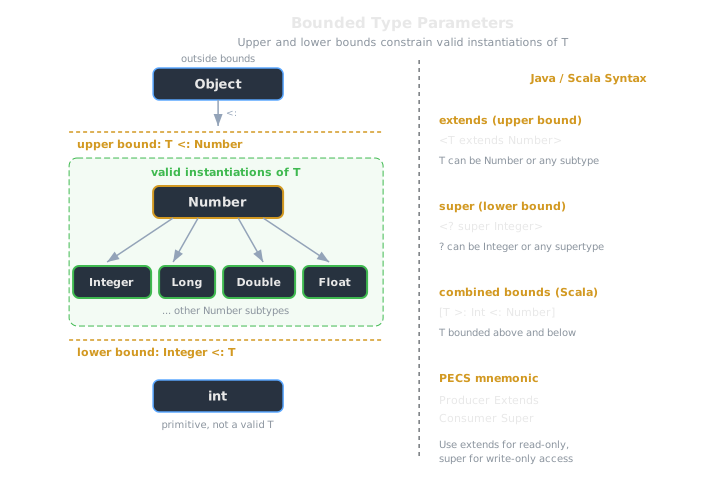
To control variance and maintain soundness, languages introduce type bounds:
Upper Bounds
T <: U: type parameter T must be a subtype of U.
class Box<T extends Number> { ... }Lower Bounds
L <: T: type parameter T must be a supertype of L.
void copy(List<? super Integer> dest, List<? extends Integer> src)These enable safe reuse across hierarchies:
-
Upper bounds restrict outputs.
-
Lower bounds restrict inputs.
Type Constraints and Type Inference
Type inference engines enforce and propagate subtyping relations:
Γ ⊢ e : A
A <: B
──────────────
Γ ⊢ e : B
This subsumption rule allows using an expression of a subtype wherever a supertype is expected.
Constraints (T <: U, L <: T) form a constraint graph, solved during compilation.
Note
In Hindley–Milner-like systems, explicit subtyping is often replaced by typeclass constraints or structural matching.
Interaction with Polymorphism
Subtyping and polymorphism interact in two main ways:
-
Ad-hoc polymorphism (overloading): multiple implementations for distinct subtypes.
-
Parametric polymorphism: one generic definition for all types.
-
Subtype polymorphism: one definition reused through subtyping hierarchy.
Tip
Languages like Scala, Kotlin, and TypeScript unify these under flexible variance annotations and bounded generics.
Conceptual Summary
| Concept | Meaning | Rule |
|---|---|---|
| Subtyping | Safe substitutability | A <: B |
| Variance | How subtyping lifts through type constructors | Covariant (+), Contravariant (-), Invariant (0) |
| Function Subtyping | Inputs contra, outputs co | (A→B) <: (A'→B') if A' <: A and B <: B' |
| Bounds | Restrict valid substitutions | T <: U, L <: T |
| Constraints | Relations solved during inference | Γ ⊢ e : A and A <: B ⇒ Γ ⊢ e : B |
See also
Sources
- “Subtyping,” Wikipedia. https://en.wikipedia.org/wiki/Subtyping . Supports subtyping as a relation
A <: Bgrounded in substitutability (a value of a subtype is usable wherever a supertype is expected), and its reflexive and transitive structure. - “Covariance and contravariance (computer science),” Wikipedia. https://en.wikipedia.org/wiki/Covariance_and_contravariance_%28computer_science%29 . Supports the covariant, contravariant, and invariant treatment of type constructors, the contravariant-input/covariant-output rule for function subtyping, and the unsoundness of covariant mutable arrays.