Ward Cunningham coined the term in 1992, and the origin story matters more than it usually gets credit for. He had just read Metaphors We Live By, and he needed a way to explain to his boss why the financial product they were building needed refactoring. The metaphor was invented as a communication device, aimed at someone holding the budget:
Shipping first time code is like going into debt. A little debt speeds development so long as it is paid back promptly with a rewrite… The danger occurs when the debt is not repaid. Every minute spent on not-quite-right code counts as interest on that debt. Entire engineering organizations can be brought to a stand-still under the debt load of an unconsolidated implementation, object-oriented or otherwise.
The idea
The debt metaphor’s real payload is that it splits an undifferentiated feeling of “this code is bad” into two separately actionable quantities. Interest is the extra effort every future change costs because of the cruft. Principal is the one-time cost of removing the cruft. Once you have both numbers, “should we clean this up” stops being a matter of taste and becomes an amortization question: pay down the principal only when the accumulated interest you expect to avoid exceeds it.
Interest and principal, in days
Martin Fowler’s worked version is deliberately small. Suppose a module structure is confusing. Adding a feature to a clean version of that structure would take four days; with the cruft it takes six. “The two day difference is the interest on the debt.”
Now consider paying the principal. Cleaning up the modular structure takes five days. If only one feature is coming, you have spent nine days instead of six, a clear loss. “But if I have two more similar features coming up, then I’ll end up faster by removing the cruft first.”
There is an honesty problem sitting underneath this arithmetic, and Fowler names it directly: because we cannot measure productivity, “none of these costs are objectively measurable.” You can estimate the feature, estimate the counterfactual clean version, and estimate the cleanup, but “our accuracy of such estimates is pretty low.” So the metaphor gives you the right shape of the decision without giving you reliable inputs.
His practical answer is the same one you would use on a real loan: pay the principal off gradually. Spend an extra couple of days on the first feature to remove some cruft, which may drop the interest on future work. The structural benefit is that this policy self-targets. Gradual improvement “naturally means we spend more time on removing cruft in those areas that we modify frequently, which are exactly those areas of the code base where we most need the cruft to be removed.”
Where the metaphor breaks
Financial interest accrues with the passage of time. Technical interest does not. As Fowler puts it, “I only trigger an interest payment when I have to work with that part of the software,” and he flags this explicitly as a place the metaphor fails. The consequence is a rule most teams get backwards: “crufty but stable areas of code can be left alone,” while areas of high activity “need a zero-tolerance attitude to cruft, because the interest payments are cripplingly high.” A horrifying module nobody touches is costing you nothing this quarter.
The quadrant
The debate Fowler was responding to in 2009 was whether messy code written by people who did not know better should count as debt at all. Robert Martin’s position was that it should not, and that the term be reserved for a considered decision to adopt an unsustainable design in exchange for a short-term benefit.
Fowler’s move was to refuse the framing. “Technical Debt is a metaphor, so the real question is whether or not the debt metaphor is helpful about thinking about how to deal with design problems, and how to communicate that thinking.” A mess still fits: it is “a reckless debt which results in crippling interest payments or a long period of paying down the principal.” So “the useful distinction isn’t between debt or non-debt, but between prudent and reckless debt.”
Crossing that with a second axis, whether the debt was taken on deliberately or inadvertently, produces a two by two.
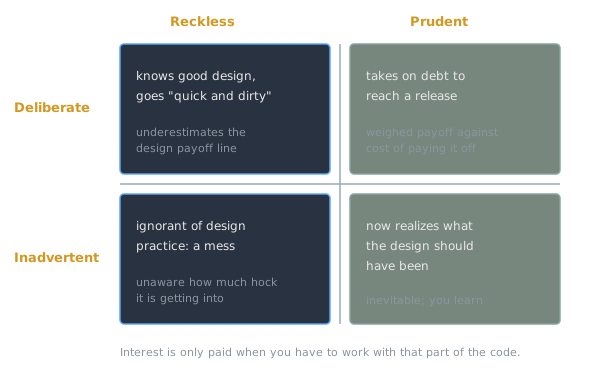
Three cells are intuitive. Prudent and deliberate is the team that knows it is borrowing and “puts some thought as to whether the payoff for an earlier release is greater than the costs of paying it off.” Reckless and inadvertent is the team “ignorant of design practices” that takes on debt “without even realizing how much hock it’s getting into.” Reckless and deliberate is the team that knows better and goes “quick and dirty” anyway because it thinks it cannot afford clean code, which Fowler judges reckless “because people underestimate where the DesignPayoffLine is.”
The fourth cell is the interesting one. Prudent and inadvertent debt sounds like a contradiction, and Fowler argues it is common and even “inevitable for teams that are excellent designers.” His example is a colleague who delivered valuable software on a happy project with clean code, and was still unhappy with it, because the team now understood what the design ought to have been. “While you’re programming, you are learning. It’s often the case that it can take a year of programming on a project before you understand what the best design approach should have been.” The moment you learn that, you have acquired a debt you never chose.
Notably, Fowler concedes this cell strains the metaphor: “I can’t conceive of a parallel with taking on a prudent-inadvertent financial debt,” which makes it hard to explain to managers. He keeps it anyway, because the interest-versus-principal decision still applies, and because expecting this debt is the point. “Even the best teams will have debt to deal with as a project goes on, even more reason not to recklessly overload it with crummy code.”
The argument the metaphor is used to lose
The most common misuse is invoking debt to justify neglecting internal quality: we need these features urgently, so we will borrow now and manage it later. Fowler’s objection is empirical, not moral. “Cruft has a quick impact, slowing down the very new features that are needed quickly.” Teams that reason this way “end up maxing out all their credit cards, but still delivering later than they would have done had they put the effort into higher internal quality.” His stated bound: trading quality for speed only works while you stay below the design payoff line, and “teams hit that line in weeks rather than months.”
The Wikipedia treatment adds a useful counterweight from the other direction. The concept presumes the expedient choice creates future cost that a different decision would have avoided, and that presumption can fail. If the system never survives long enough to be modified for a subsequent release, “the savings due to the expedient development choices are true savings since there is no future development cost.” A prototype that gets thrown away had no debt, only a bill nobody had to pay.
Tip
Debt is not the only lens on this. In 1980 Meir Lehman stated a related law about the same phenomenon without the finance framing: “As an evolving program is continually changed, its complexity, reflecting deteriorating structure, increases unless work is done to maintain or reduce it.” Lehman describes the physics. Cunningham’s metaphor describes what to do about it in language a budget holder understands, which is precisely why it won.
Related Notes
- Refactoring - the operation that pays down principal without changing behavior
- Testing Strategies - the safety net that makes paying down debt affordable
- Software Architecture - where structural debt accumulates and gets expensive
- Design Patterns - a shared vocabulary for the structures cruft erodes
- Code Review - the checkpoint where inadvertent debt is most cheaply caught
Sources
- “Technical Debt,” Martin Fowler. https://martinfowler.com/bliki/TechnicalDebt.html . Supports the cruft framing and interest as the extra effort to add features; the four-versus-six-day interest example and the five-day principal example with the two-more-features break-even; the inability to measure productivity making these costs not objectively measurable and estimate accuracy being low; paying principal gradually and its self-targeting toward frequently modified areas; interest being triggered by working with the code rather than by time and this being where the metaphor breaks down; leaving crufty but stable code alone and zero tolerance in high-activity areas; the maxing-out-credit-cards failure of using debt to justify neglecting quality; and teams hitting the design payoff line in weeks rather than months.
- “Technical Debt Quadrant,” Martin Fowler. https://martinfowler.com/bliki/TechnicalDebtQuadrant.html . Supports Uncle Bob’s “a mess is not a debt” position and Fowler’s response that the real question is whether the metaphor is helpful; a mess as reckless debt; the prudent-versus-reckless distinction being the useful one; the deliberate-versus-inadvertent second axis and the descriptions of all four cells including the prudent-inadvertent colleague anecdote; the year-of-programming learning claim; the admission that no financial parallel to prudent-inadvertent debt exists; and the closing point that even the best teams accumulate debt.
- “Technical debt,” Wikipedia. https://en.wikipedia.org/wiki/Technical_debt . Supports Cunningham coining the term in 1992 after reading Metaphors We Live By to explain refactoring a financial product to his boss, the verbatim shipping-first-time-code quotation, Lehman’s 1980 law on deteriorating structure, and the limitation that expedient savings are real if the system is never modified again.