Intuition
If events arrive according to a Poisson process (independently, at a constant average rate), the exponential distribution describes how long you wait between consecutive events. It is the continuous counterpart of the geometric distribution and shares its memoryless property: the probability of waiting at least more units is the same regardless of how long you have already waited.
Definition
A random variable follows an exponential distribution if it represents the time (or distance) between successive events in a Poisson process with mean inter-arrival time .
takes non-negative real values .
Parameterization note: some texts use the rate directly, writing . The formulas below use (mean lifetime) as the parameter.
Key Formulas
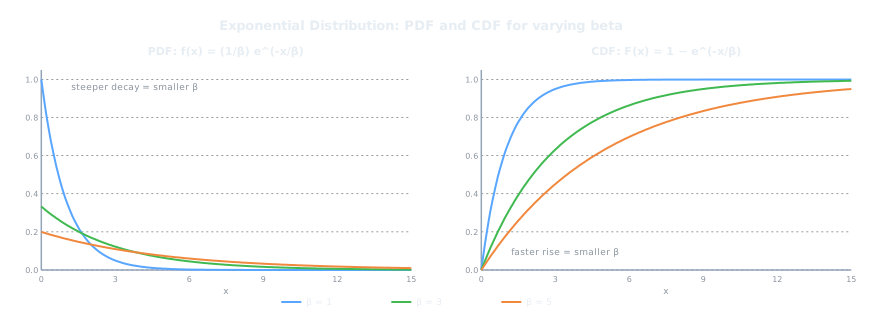
Probability Density Function (PDF):
Cumulative Distribution Function (CDF):
Mean:
Variance:
Memoryless Property:
This is the only continuous distribution with this property. It means past survival gives no information about remaining lifetime.
Relationship to Poisson:
If events arrive at rate , then inter-arrival times are and the count in time is .
Example
An electronic component has an average life of years (exponentially distributed). What is the probability it lasts more than 8 years?
There is roughly a 20% chance the component survives past 8 years. Notice that, by the memoryless property, a component that has already lasted 3 years still has the same 20% chance of lasting 8 more years beyond that point:
We can also compute the median lifetime. Setting :
The median is always less than the mean for an exponential distribution, reflecting its right skew.
Hazard rate: the exponential has a constant hazard (failure) rate . This means a 5-year-old component is no more likely to fail in the next instant than a brand-new one - a strong assumption that limits the model to components without wear-out.
Why It Matters in CS
- Reliability engineering: Mean Time Between Failures (MTBF) for hardware components is modelled exponentially, enabling maintenance scheduling and redundancy planning.
- Operating systems: process service times in scheduling analysis often assume exponential distributions, yielding tractable queueing models (M/M/1).
- Web server performance: response-time modelling uses exponential assumptions for service duration, driving capacity planning and load balancer configuration.
- Simulation: generating exponential random variates via the inverse-transform method (, where ) is a building block of discrete-event simulation.
Related Notes
- Poisson Distribution - counts events in an interval; the exponential models time between those events
- Normal Distribution - another foundational continuous distribution, used when many independent factors combine additively
- Probability Distributions - overview of the broader distribution taxonomy