Overview
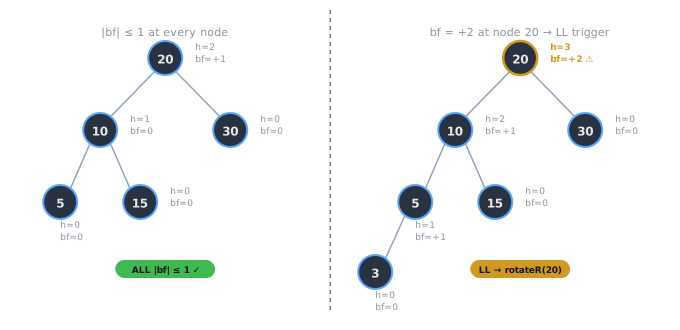
AVL trees maintain balance by ensuring that for any node, the height difference between its left and right subtrees is at most one.
When this condition is violated, rotations restore balance while keeping the binary search tree (BST) property intact.
Note
Balance factors allow AVL trees to detect imbalance locally and correct it with minimal rotations.
Cases
When inserting or deleting a node:
- Recompute height and balance factor up the tree.
- Identify the first node that violates the AVL condition (
|balance_factor| > 1). - Perform the appropriate rotation based on the shape of imbalance.
| Case | Description | Rotation Needed |
|---|---|---|
| LL | Left subtree of left child grew | Right rotation |
| RR | Right subtree of right child grew | Left rotation |
| LR | Right subtree of left child grew | Left rotation on child, then right rotation |
| RL | Left subtree of right child grew | Right rotation on child, then left rotation |
Right Rotation (LL Case)
Occurs when inserting into the left subtree of a node’s left child.
function rotateRight(y):
    x = y.left
    T2 = x.right
    x.right = y
    y.left = T2
    updateHeight(y)
    updateHeight(x)
    return x
After rotation:
-
Node
xbecomes new root of subtree. -
The order property is preserved: all keys in
T2remain betweenxandy.
Left Rotation (RR Case)
Occurs when inserting into the right subtree of a node’s right child.
function rotateLeft(x):
    y = x.right
    T2 = y.left
    y.left = x
    x.right = T2
    updateHeight(x)
    updateHeight(y)
return y-
Node
ybecomes new root of subtree. -
Subtree heights become balanced (
balance_factor = 0).
Left-Right (LR Case)
Triggered when inserting into the right subtree of the left child:
-
Perform a left rotation on the left child.
-
Then perform a right rotation on the root.
Right-Left (RL Case)
Triggered when inserting into the left subtree of the right child:
-
Perform a right rotation on the right child.
-
Then perform a left rotation on the root.
Note
LR and RL rotations are effectively mirror images of each other.
Transition Rules
Detecting imbalance and choosing the fix. Use the sign of the ancestor’s balance factor and the direction of growth in the child to select LL, RR, LR, or RL. Rotations restructure subtrees while preserving the in-order sequence.
Height updates after rotation
Update child heights first, then parent/root of the rotated subtree; verify bf() ∈ {-1,0,+1}.
function insert(node, key):
    if node == null:
        return new Node(key)
    if key < node.key:
        node.left = insert(node.left, key)
    else if key > node.key:
        node.right = insert(node.right, key)
    else:
        return node  // duplicate keys ignored

    updateHeight(node)
    balance = height(node.left) - height(node.right)

    if balance > 1 and key < node.left.key:
        return rotateRight(node)           // LL
    if balance < -1 and key > node.right.key:
        return rotateLeft(node)            // RR
    if balance > 1 and key > node.left.key:
        node.left = rotateLeft(node.left)  // LR
        return rotateRight(node)
    if balance < -1 and key < node.right.key:
        node.right = rotateRight(node.right) // RL
        return rotateLeft(node)
    return node
Tip
Track heights as integers and only recompute from children - never traverse entire subtrees.
Rebalancing on deletion. Deletions may cause cascading imbalance upward, so after removing a node:
-
Recompute height.
-
Recheck balance and apply the same rotation logic.
-
Continue until reaching the root.
Warning
Deletion can trigger multiple rotations because balance violations can propagate upward.
Examples
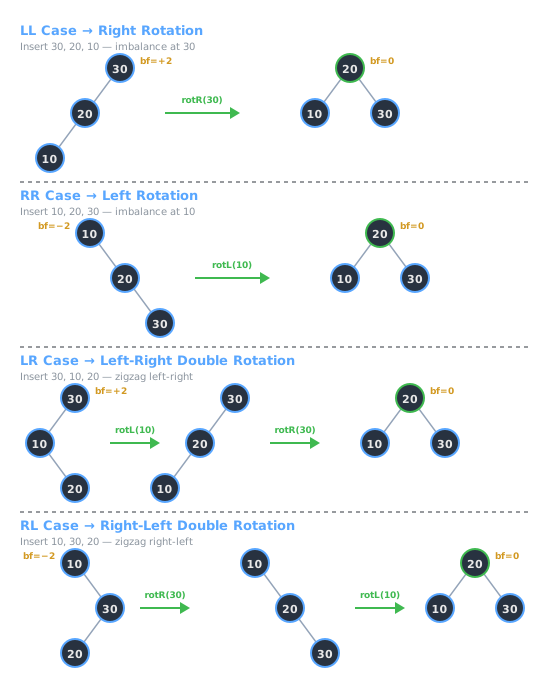
Rotation intuition. Rotations don’t reorder values - they restructure subtrees so height differences shrink while key ordering stays intact.
| Rotation | Restores | Description |
|---|---|---|
| LL / RR | Single imbalance | Straight chain fix |
| LR / RL | Diagonal imbalance | Two-step correction |
Example
Visualize how a “leaning” subtree becomes upright after rotation - the parent node moves downward, and the child moves up.
Minimal worked examples (one per case):
-
LL: Insert sequence
30, 20, 10→ imbalance at30(left-left) →rotateRight(30). -
RR: Insert sequence
10, 20, 30→ imbalance at10(right-right) →rotateLeft(10). -
LR: Insert sequence
30, 10, 20→ imbalance at30(left-right) →rotateLeft(10), thenrotateRight(30). -
RL: Insert sequence
10, 30, 20→ imbalance at10(right-left) →rotateRight(30), thenrotateLeft(10).
Pitfalls
Common pitfalls
Wrong pivot order on LR/RL (double rotations).
Forgetting to recompute heights after each sub-rotation.
Not rechecking ancestors on the search path for further imbalance.