Overview
Tree traversal is the disciplined process of visiting every node of a tree in a well-defined order. Traversal orders drive nearly every tree algorithm: searching, aggregating values, transforming structures, serializing/deserializing, and checking invariants. Two broad families dominate:
- Depth-First Search (DFS): visit a subtree completely before moving to siblings. Canonical orders on binary trees are preorder, inorder, and postorder.
- Breadth-First Search (BFS): visit nodes by levels using a queue.
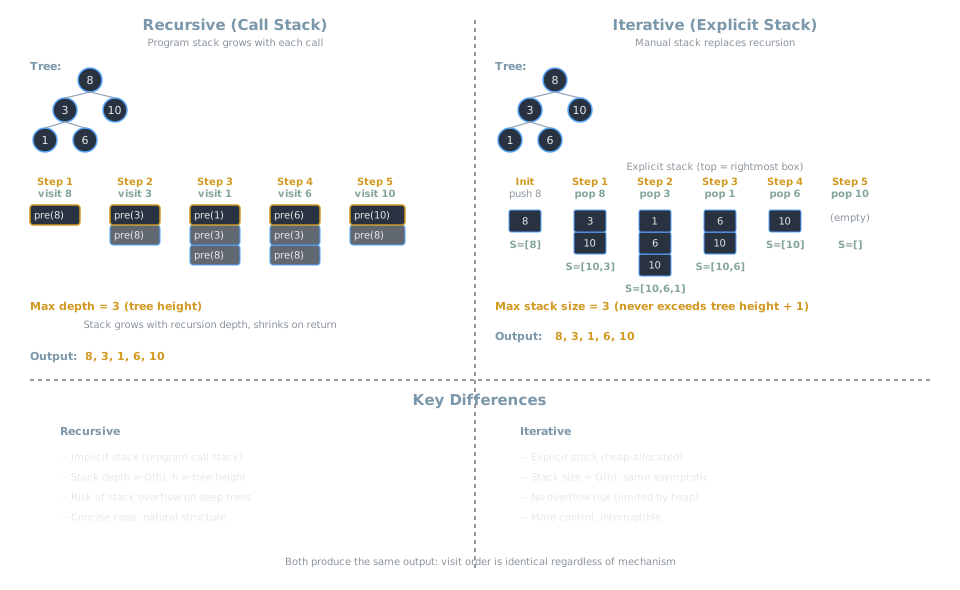
Each order admits a recursive version (via the program stack) and an iterative version (using an explicit stack or queue). The choice affects stack depth, memory use, and control over side effects.
Note
Throughout, assume a binary-tree node with fields
Node.left,Node.right, and possiblyNode.children[]for general trees. For binary search trees (BSTs), inorder yields keys in sorted order; see Traversal — Inorder and Binary Tree.
Motivation
Picking the right traversal gives you:
- Correctness by construction: e.g., postorder naturally ensures children are processed before their parent—ideal for deletion or bottom-up DP.
- Clarity of intent: preorder aligns with serialization (“emit root before its subtree”), inorder with BST iteration, level order with shortest number of edges from root properties.
- Performance predictability: DFS uses at most the height of the tree in extra memory; BFS uses at most the size of the widest level.
Definition and Formalism
Let T be a (rooted) tree with root r.
- Preorder (Root, Left, Right): visit
r, then visit each child’s subtree recursively. On binary trees:R-L-R. - Inorder (Left, Root, Right): visit left subtree, then
r, then right subtree (binary trees only). - Postorder (Left, Right, Root): visit subtrees first, then
r. - Level order (BFS): visit nodes in increasing depth from
rusing a FIFO queue.
All standard traversals are Θ(n) time for n nodes and, in trees without cross-links, scan each edge exactly once.
Tip
For k-ary or general trees (arbitrary arity), preorder and postorder generalize directly by looping over
children. “Inorder” is inherently binary; for higher arity, define a domain-specific “inorder-like” order if needed.
Example or Illustration
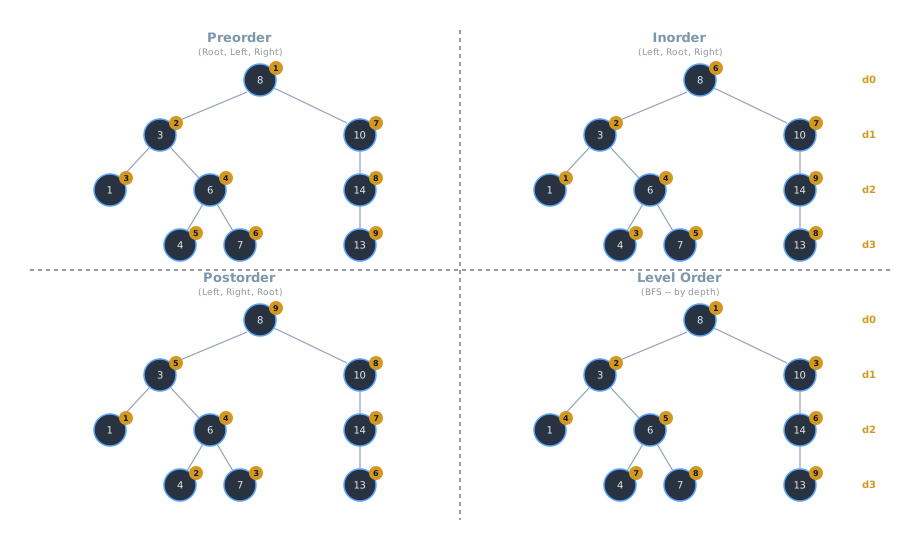
Consider a binary tree with values:
8 / \
3 10
/ \
1 6 14
/ \ /
4 7 13
- Preorder: 8, 3, 1, 6, 4, 7, 10, 14, 13
- Inorder: 1, 3, 4, 6, 7, 8, 10, 13, 14 (sorted because it’s a BST)
- Postorder: 1, 4, 7, 6, 3, 13, 14, 10, 8
- Level order: 8, 3, 10, 1, 6, 14, 4, 7, 13
Recursive Skeletons (Binary Trees)
function PREORDER(u):
    if u == null: return
    visit(u)
    PREORDER(u.left)
    PREORDER(u.right)

function INORDER(u):
    if u == null: return
    INORDER(u.left)
    visit(u)
    INORDER(u.right)

function POSTORDER(u):
    if u == null: return
    POSTORDER(u.left)
    POSTORDER(u.right)
    visit(u)
Level order (BFS):
function LEVEL_ORDER(root):
    if root == null: return
    Q = queue()
    Q.enqueue(root)
    while not Q.empty():
        u = Q.dequeue()
        visit(u)
        if u.left  != null: Q.enqueue(u.left)
        if u.right != null: Q.enqueue(u.right)
Note
Replace
visit(u)with any side effect: printing, summing, computing heights, serializing, etc.
Iterative Patterns
Preorder (explicit stack)
function PREORDER_IT(root):
    if root == null: return
    S = stack()
    S.push(root)
    while not S.empty():
        u = S.pop()
        visit(u)
        if u.right != null: S.push(u.right) // push right first
        if u.left  != null: S.push(u.left)  // so left is processed next
Inorder (explicit stack)
function INORDER_IT(root):
    S = stack()
    u = root
    while u != null or not S.empty():
        while u != null:
            S.push(u)
            u = u.left
        u = S.pop()
        visit(u)
        u = u.right
Postorder (two stacks or one stack + last-visited)
Two-stack variant:
function POSTORDER_TWO_STACKS(root):
    if root == null: return
    S1 = stack(); S2 = stack()
    S1.push(root)
    while not S1.empty():
        u = S1.pop()
        S2.push(u)
        if u.left  != null: S1.push(u.left)
        if u.right != null: S1.push(u.right)
    while not S2.empty():
        visit(S2.pop())
One-stack variant (track last visited):
function POSTORDER_ONE_STACK(root):
    S = stack()
    u = root
    last = null
    while u != null or not S.empty():
        if u != null:
            S.push(u)
            u = u.left
        else:
            peek = S.top()
            if peek.right != null and last != peek.right:
                u = peek.right
            else:
                visit(peek)
                last = S.pop()
Level order with level boundaries
function LEVEL_ORDER_WITH_LEVELS(root):
    if root == null: return
    Q = queue()
    Q.enqueue(root)
    while not Q.empty():
        size = Q.size()
        // process all nodes at this depth
        for k in 1..size:
            u = Q.dequeue()
            visit(u)
            if u.left  != null: Q.enqueue(u.left)
            if u.right != null: Q.enqueue(u.right)
        end_level()  // optional hook (e.g., newline)
Tip
Iterative forms provide explicit control over data structures. Use them to avoid deep recursion, to integrate with custom allocators, or to interleave traversal with other iterators.
Accumulation Patterns (What to Do During visit)
-
Aggregates: subtree sizes, sums, min/max—often simplest in postorder (children computed first).
-
Structural checks: BST validity (inorder should be non-decreasing), heap property, balance factors.
-
Transformations: map/filter on trees; cloning (preorder copies node then recurses); freeing memory (postorder) so children are released before parent.
-
-
Preorder with null markers yields a unique encoding for general binary trees.
-
Level order yields compact layout for complete trees (array-based heaps).
-
Example
Computing heights:
height(u) = 1 + max(height(u.left), height(u.right))(postorder).
Accumulating running sum for root-to-leaf paths: passsumSoFarin preorder and record at leaves.
Complexity and Space Usage
For n nodes:
-
Time: All standard traversals are
Θ(n). -
Space (extra):
-
Recursive DFS:
Θ(h)stack frames, wherehis tree height (Θ(log n)on balanced trees,Θ(n)on skewed trees). -
Iterative DFS with stack:
Θ(h)worst-case. -
BFS:
Θ(w)wherewis the maximum width (nodes on the largest level). On complete trees,w = Θ(n)at the last level.
-
Note
For complete binary trees, BFS may queue roughly
n/2nodes near the bottom level. Prefer DFS when memory is tight and you do not need level structure.
Common Pitfalls or Edge Cases
Warning
Null handling and sentinel confusion. Always guard
nullchild pointers before pushing/enqueuing. For implicit (array) trees, derive child indices carefully to avoid out-of-bounds; see Binary Heap for index formulas.
Warning
Stack overflow with deep recursion. Skewed trees can exceed recursion limits. Use iterative variants for unbalanced inputs or increase limits cautiously.
Warning
Mixing orders accidentally. Tiny changes in push order flip traversal results (e.g., pushing left before right vs the reverse). Write small tests asserting expected sequences.
Warning
Stateful visits with side effects. If
visitmutates structure (e.g., deleting nodes), ensure the traversal order still visits all intended nodes safely—postorder is safest for destructive operations.
Warning
Inorder assumptions outside BSTs. Only BSTs guarantee sorted order under inorder; for arbitrary binary trees, inorder is just a convention.
Implementation or Practical Context
-
Iterative vs recursive: Iterative gives explicit control over memory and is safer for unknown depths; recursive is concise and often faster to write/read.
-
Morris traversals (advanced): Preorder/inorder without extra memory by temporarily “threading” the tree via right pointers; restores structure on exit. This achieves
Θ(1)extra space but complicates code and pointer invariants. -
General trees: Replace
left/rightwith a loop overchildren[]. “Inorder” must be defined per domain (e.g., N-ary trees may choose an indexkto visit before root, then remaining). -
Parallelism: BFS lends itself to level-parallel processing. DFS parallelism is possible by task spawning on subtrees (avoid oversubscription with a threshold).
-
Testing harness: For each order, build small canonical trees and assert known sequences. Add randomized shape generators to catch push-order bugs.
Tip
When exposing iteration APIs, provide all four:
preorder(),inorder(),postorder(),levelOrder(). For BSTs, makeinorder()the default iterator sofor x in bstyields sorted keys.
Summary
Traversal orders are contracts about when a node is visited relative to its children:
-
Preorder: visit before children — ideal for cloning, serialization, and pre-compute passes.
-
Inorder: visit between children — exposes sorted order in BSTs.
-
Postorder: visit after children — natural for deletions, frees, and bottom-up DP.
-
Level order (BFS): visit by depth — best for breadth properties, shortest-edge layers, and level-wise aggregation.
All run in Θ(n) time; pick recursive vs iterative to balance simplicity, depth safety, and memory. Combine traversal with accumulation to implement practical algorithms cleanly and safely.