Overview
A B-tree is a self-balancing multiway search tree that generalizes binary search trees to support multiple keys per node.
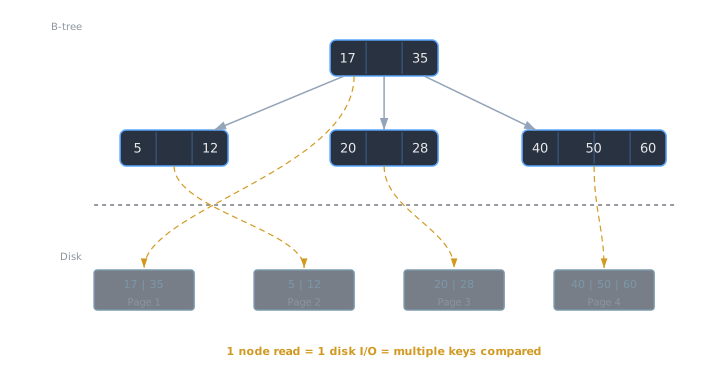
It minimizes disk I/O by storing large blocks of sorted keys together—ideal for databases and filesystems where nodes map directly to disk pages.
Note
B-trees are optimized for external memory: instead of minimizing CPU comparisons, they minimize the number of disk reads required to locate data.
Motivation
Standard binary search trees degrade to height O(n) in the worst case, while AVL and Red-Black trees—though balanced—are inefficient for disk storage, as each node often triggers separate disk access.
A B-tree solves this by:
- Storing many keys per node (reducing height).
- Ensuring logarithmic depth even for large datasets.
- Aligning node size with disk block or cache line size to maximize locality.
Structure & Properties
A B-tree of order m (the maximum number of children per node) satisfies:
- Node capacity:
ceil(m/2) − 1 ≤ keys ≤ m − 1
ceil(m/2) ≤ children ≤ m
- Sorted order: Keys within a node are sorted.
- Child partitioning:
Keys separate subranges:
For node with keys[k₁, k₂, …, kₜ], childC₀contains< k₁,C₁betweenk₁andk₂, etc. - Balanced height: All leaves appear at the same depth.
- Root rules: The root can have fewer keys (≥1) and fewer children.
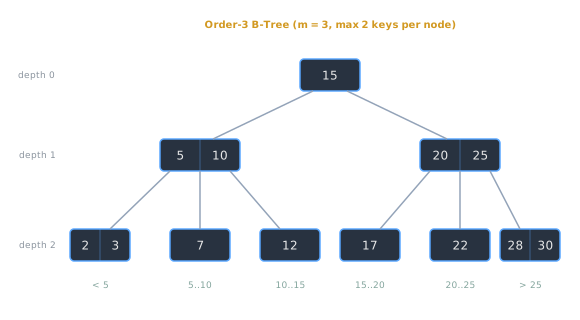
Example
For m = 4, each node can contain up to 3 keys and 4 children.
  [17 | 35]
 /     |     \
[5 | 12] [20 | 28] [40 | 50 | 60]
Searching for 28:
- Compare in root
[17 | 35]→ between → follow middle child[20 | 28]→ found.
Tip
B-trees reduce the number of node visits dramatically—depth grows logarithmically with branching factor
m.
Insertion Algorithm
1. Locate target leaf
Traverse like a BST, descending to the correct child based on key order.
2. Insert key
Insert in sorted order into the leaf.
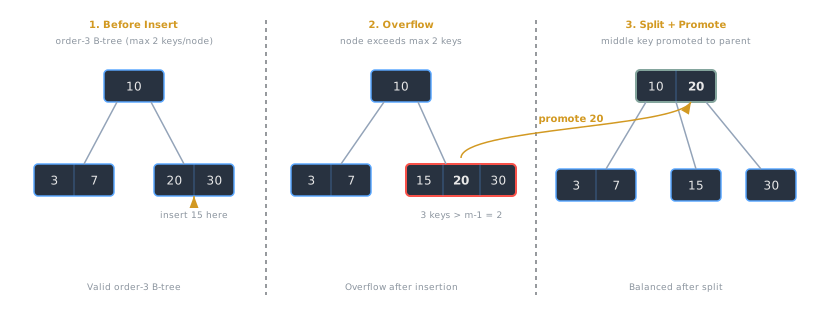
3. Handle overflow
If a node exceeds (m − 1) keys:
- Split the node into two halves.
- Promote the middle key to the parent.
- If parent overflows, recursively split upward (possibly creating a new root).
Pseudocode
function insert(T, k):
    if root is full:
        s = newNode()
        s.children[0] = root
        splitChild(s, 0)
        root = s
    insertNonFull(root, k)

function insertNonFull(x, k):
    if x is leaf:
        insert k into x.keys
    else:
        i = largest i where k > x.keys[i]
        if child[i+1] is full:
            splitChild(x, i+1)
            if k > x.keys[i+1]:
                i = i + 1
        insertNonFull(x.children[i+1], k)
Deletion Algorithm
-
Find key
k:-
If in leaf: remove directly.
-
If in internal node: replace with predecessor or successor key and recursively delete that key.
-
-
Fix underflow:
If a node drops belowceil(m/2) − 1keys:-
Borrow a key from a sibling, or
-
Merge with a sibling and pull down a key from the parent.
-
Warning
Deletion rebalancing can cascade upward — similar to insert splitting, but reversed.
Time & Space Complexity
| Operation | Time | Space | Notes |
|---|---|---|---|
| Search | O(logₘ n) | O(1) | Each level reads one node. |
| Insert | O(logₘ n) | O(1) | One split per level max. |
| Delete | O(logₘ n) | O(1) | Merge or borrow per level. |
| Traversal | O(n) | O(1) | In-order traversal yields sorted output. |
Note
Increasing
mreduces height and improves I/O locality but increases per-node linear search cost.
B-Trees in Storage Systems
Databases
-
Used in B+Trees, a variant with all data in leaves and linked leaf nodes for range queries.
-
Enables efficient range scans and prefix lookups.
-
Balanced automatically on insertion/deletion.
File Systems
-
File allocation tables and metadata indices use B-tree variants.
-
Example: HFS+, NTFS, ext4.
B-Tree vs Other Trees
| Property | B-Tree | BST | AVL | Red-Black | B+Tree |
|-----------|---------|------|-------------|---------|
| Keys per node | Multiple | 1 | 1 | 1 | Multiple |
| Disk alignment | Yes | No | No | No | Yes |
| Balance guarantee | Strict | Unbounded | Height-balanced | Loosely balanced | Strict |
| Range queries | Moderate | Poor | Poor | Poor | Excellent |
| Storage use | Block-based | Pointer-heavy | Pointer-heavy | Pointer-heavy | Block-based |
Pitfalls
Warning
Underflow handling during deletion is often overlooked.
Borrowing from or merging with siblings must maintain key ordering and node capacity invariants.
Warning
Incorrect split propagation: always promote the median key upward, not the last inserted one.
Tip
Choose node size based on disk block or page size (e.g., 4 KB) to align with storage system granularity.
Summary
-
B-trees are balanced, disk-friendly structures ensuring logarithmic access time.
-
Designed for large datasets stored on disk or secondary memory.
-
Maintain order and balance through split and merge operations.
-
Foundation of many modern B+Tree-based databases and filesystems.