Overview
A Binary Search Tree (BST) is a hierarchical data structure that stores elements in a sorted manner, allowing efficient search, insertion, and deletion operations.
Each node has up to two children — left and right — arranged by the BST invariant:
For every node x:
all keys in left(x) < key(x) < all keys in right(x)
Note
BSTs form the foundation for self-balancing structures such as AVL trees, Red-Black trees, and Splay trees.
Node Structure
Each node stores a key (and optionally a value) and pointers to its children.
struct Node {
    key
    left, right
}
Tip
Some implementations also store a parent pointer or subtree metadata (e.g., height, size).
Operations
| Operation | Average Time | Worst Case | Space |
|---|---|---|---|
| Search | O(log n) | O(n) | O(1) |
| Insert | O(log n) | O(n) | O(1) |
| Delete | O(log n) | O(n) | O(1) |
| Traversal | O(n) | O(n) | O(1) |
The efficiency depends on tree height — ideally O(log n) but can degrade to O(n) if the tree becomes skewed.
Searching for a Key
function search(node, key):
    if node == null or node.key == key:
        return node
    if key < node.key:
        return search(node.left, key)
    else:
        return search(node.right, key)
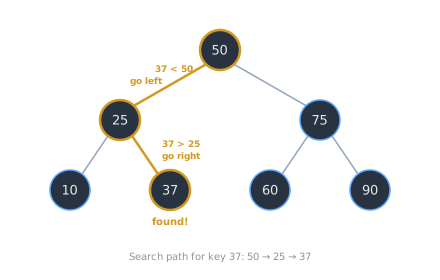
The search path follows comparisons — left for smaller, right for larger.
Insertion
function insert(node, key):
    if node == null:
        return new Node(key)
    if key < node.key:
        node.left = insert(node.left, key)
    else if key > node.key:
        node.right = insert(node.right, key)
    return node
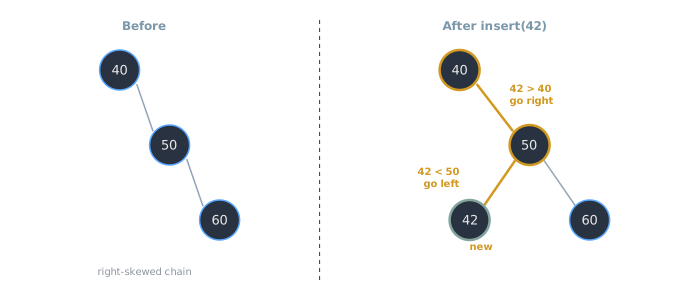
Insertion preserves the ordering invariant by recursively finding the correct null link.
Duplicate Policy
There are three common approaches:
-
Reject duplicates entirely.
-
Allow duplicates on one side (usually right).
-
Use counts or linked lists at nodes.
Warning
Duplicate-handling must be consistent — mixing policies can silently violate ordering.
Deletion
Deletion is more complex and has three cases:
1. Node is a Leaf
Remove it directly.
2. Node has One Child
Replace the node with its child.
3. Node has Two Children
Find the inorder successor (smallest node in right subtree) or predecessor (largest in left subtree).
Copy its value into the current node, then delete the duplicate from the subtree.
function delete(node, key):
    if node == null:
        return null
    if key < node.key:
        node.left = delete(node.left, key)
    else if key > node.key:
        node.right = delete(node.right, key)
    else:
        if node.left == null:
            return node.right
        if node.right == null:
            return node.left
        successor = minValueNode(node.right)
        node.key = successor.key
        node.right = delete(node.right, successor.key)
    return node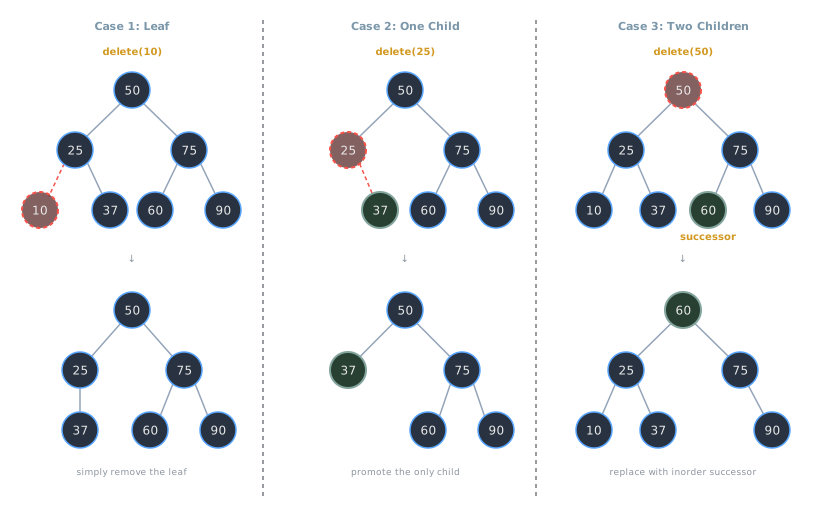
Traversals
Inorder Traversal
function inorder(node):
    if node != null:
        inorder(node.left)
        visit(node)
        inorder(node.right)
Produces sorted output of keys.
Preorder / Postorder
Used for copying or deleting the tree respectively.
| Type | Order | Use |
|---|---|---|
| Inorder | Left → Root → Right | Sorted listing |
| Preorder | Root → Left → Right | Tree construction |
| Postorder | Left → Right → Root | Deletion or evaluation |
Height and Balance
The height of a BST affects its performance.
-
Best case (balanced):
h ≈ log₂(n) -
Worst case (skewed):
h = n
A skewed BST behaves like a linked list; self-balancing variants (AVL, Red-Black) mitigate this by maintaining bounded height.
Tip
Use random insertion or balancing logic to maintain logarithmic height.
Example Trace
Consider inserting keys [50, 25, 75, 10, 37, 60, 90].
After construction:
        50
       /  \
     25    75
    / \    / \
   10 37  60 90
Inorder traversal yields [10, 25, 37, 50, 60, 75, 90].
Common Pitfalls
Warning
Parent link updates: If nodes store parent references, update them during insertions and deletions.
Warning
Unbalanced growth: Sequential insertions (
1, 2, 3, ...) degrade to O(n) time — use balancing or randomization.
Warning
Incorrect duplicate handling: Failing to define a side (left/right) for equal keys breaks ordering.
Summary
-
BST maintains ordered keys with hierarchical structure.
-
Search, insert, delete average O(log n) when balanced.
-
Inorder traversal always yields sorted sequence.
-
Basis for advanced balanced trees like AVL and Red-Black Trees.