Overview
Depth-First Search (DFS) explores a graph by recursing (or using an explicit stack) along each path as far as possible before backtracking. Classic DFS records discovery and finish timestamps for each vertex, yielding a DFS forest and enabling edge classification (tree, back, forward, cross). These artifacts power cycle detection, connectivity analyses, and Topological Sorting.
Core Idea
Treat the graph as an adjacency mapping Adj[u]. Mark vertices white → gray → black as they transition from unvisited to discovered (on stack) to finished. Increment a global time at each discovery/finish to get intervals [d[u], f[u]]. In directed graphs, intervals nest along recursion; a back edge from u to an ancestor in the current recursion stack proves a cycle.
Algorithm Steps / Pseudocode
The recursive version below computes timestamps, parents, and classifies edges during traversal.
function DFS(G):
    for each u in V(G):
        color[u] = WHITE
        parent[u] = NIL
    time = 0
    for each u in V(G):
        if color[u] == WHITE:
            DFS_VISIT(G, u)

function DFS_VISIT(G, u):
    color[u] = GRAY
    time = time + 1
    d[u] = time
    for each v in Adj[u]:
        if color[v] == WHITE:
            edge_class(u,v) = TREE
            parent[v] = u
            DFS_VISIT(G, v)
        else if color[v] == GRAY:
            edge_class(u,v) = BACK
        else:  // color[v] == BLACK
            // Use discovery/finish times to distinguish:
            // if d[u] < d[v] and f[v] not set yet (or f[v] > f[u]): FORWARD else CROSS
            if d[u] < d[v] and f[v] is not yet set:
                edge_class(u,v) = FORWARD
            else:
                edge_class(u,v) = CROSS
    color[u] = BLACK
    time = time + 1
    f[u] = time
Iterative stack form mirrors DFS_VISIT by pushing (u, iterator over Adj[u]) frames and simulating recursion; timestamps occur on first touch (discover) and when an iterator exhausts (finish).
Tip
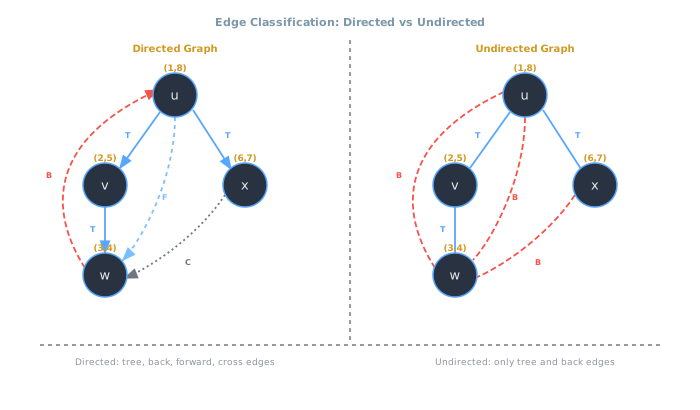
On undirected graphs, every non-tree edge encountered is a back edge (no forward/cross distinction). Use
parentto avoid classifying the immediate tree edge back to the parent as a back edge.
Example or Trace
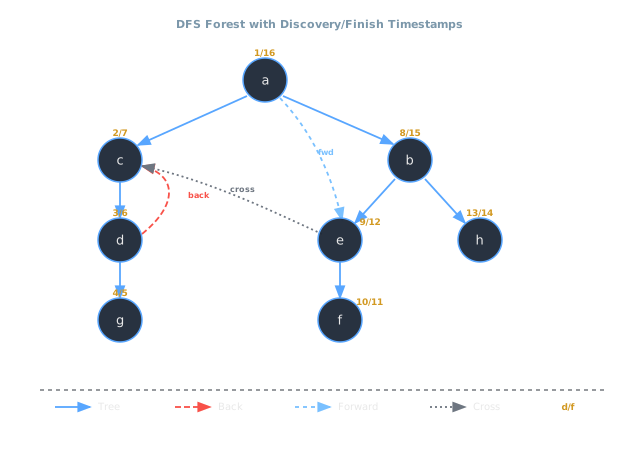
Suppose G is directed with vertices a..h. Start from a; follow a→c→d→g, then backtrack, exploring remaining edges in adjacency order. The timestamp table might look like:
| u | d[u] | f[u] | parent |
|---|---|---|---|
| a | 1 | 16 | NIL |
| c | 2 | 7 | a |
| d | 3 | 6 | c |
| g | 4 | 5 | d |
| b | 8 | 15 | a |
| e | 9 | 12 | b |
| f | 10 | 11 | e |
| h | 13 | 14 | b |
Edges like d→c encountered while c is GRAY classify as back; an edge from a to already-finished e is forward/cross depending on timestamps.
Complexity Analysis
Let n = |V| and m = |E|.
-
Time:
O(n + m)(each vertex/edge processed a constant number of times). -
Space:
O(n)for color/parent/timestamps; recursion uses up toO(n)call frames (or an explicit stack of the same size).
Optimizations or Variants
-
Edge-order control: Reordering
Adj[u]changes DFS trees and edge classes but not correctness; choose orders to expose desirable structures (e.g., lexical order for deterministic trees). -
Iterative DFS: Avoids recursion limits; necessary for very deep graphs or constrained environments.
-
Kosaraju/Tarjan scaffolding: Run DFS to compute finishing-time order or low-link values for SCCs or articulation points/bridges in linear time.
-
Pruning by components: In sparse graphs, pre-partition connected components to parallelize per-component DFS safely.
Applications
-
Cycle detection: Back edges in directed graphs imply cycles immediately.
-
Topological order: Reverse of vertex finish order yields a topological order in DAGs.
-
Strongly connected components: DFS postorder (Kosaraju) or low-link (Tarjan).
-
Articulation points/bridges: Undirected DFS with low-link compares
d[u]with descendants’ reach.
Common Pitfalls or Edge Cases
Warning
Recursion depth limits. Real graphs can have depth
Θ(n). Use an iterative DFS or raise recursion limits to avoid stack overflow.
Warning
Visited timing bugs. Mark on discovery (set
GRAYbefore exploring neighbors). Marking after exploring can re-enter the same vertex and misclassify edges.
Warning
Parent back-edge confusion (undirected). When seeing
vasGRAY, ensurev ≠ parent[u]before labeling back.
Implementation Notes or Trade-offs
-
Timestamp integrity: Increment time exactly once at discovery and once at finish to keep interval nesting valid.
-
Storage layout: Iterative DFS benefits from compact adjacency (
Adj[u]in contiguous arrays) and a manual stack frame{u, next-index}to minimize overhead. -
Determinism: To get reproducible forests, sort adjacency lists; otherwise DFS trees vary with input order.
Summary
DFS performs a deep exploration that yields a DFS forest, timestamps, and edge classifications in linear time. These outputs are the backbone for cycle detection, topological ordering, SCCs, and articulation/bridge analyses. Use timestamps to reason about ancestry (d[]/f[] nesting), and prefer an iterative stack on deep or adversarial inputs.