Overview
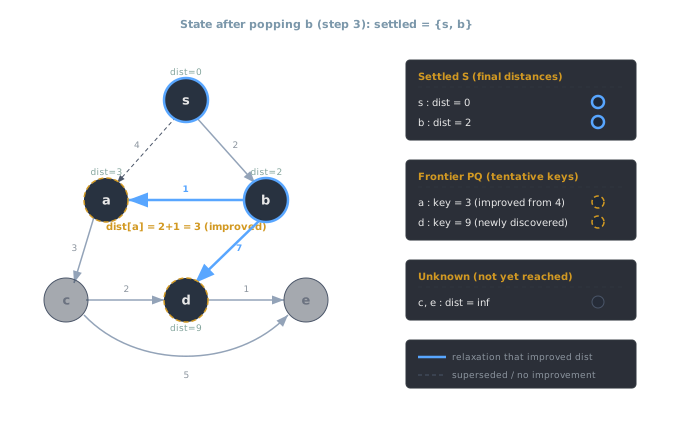
Dijkstra’s algorithm computes single-source shortest paths in graphs with non-negative edge weights. It maintains a set S of settled vertices (final distances) and a priority queue keyed by current best tentative distances for a frontier of discovered vertices. Each step removes the vertex with minimum tentative distance, relaxes its outgoing edges, and repeats until all reachable vertices are settled. The method is correct because removing the smallest tentative distance is safe when all edges are non-negative.
Core Idea
Maintain distances dist[u] initialized to ∞ (dist[s]=0). Use a min-priority queue keyed by dist. Repeatedly:
-
Extract-min
ufrom the PQ (this finalizesdist[u]). -
For each outgoing edge
(u,v,w≥0), attempt relaxation: ifdist[u]+w < dist[v], updatedist[v]and parentπ[v]=u, and reflect the new key in the PQ.
Non-negativity ensures the smallest tentative distance is globally minimal among all unsettled vertices, so once popped, a vertex’s distance cannot be improved.
Algorithm Steps / Pseudocode
G is directed or undirected with non-negative weights. Two PQ patterns are common:
-
Decrease-key: maintain one handle per vertex in the PQ and decrease its key on improvement.
-
Push-many (no decrease-key): push a new pair
(dist[v], v)whenever improved; when a popped pair is stale (doesn’t matchdist[v]), skip it.
function DIJKSTRA(G, s):
    for each vertex v in V(G):
        dist[v] = ∞
        π[v] = NIL
    dist[s] = 0

    // choose one:
    // (A) decrease-key structure
    PQ = new MinPQ()
    for each v in V(G):
        PQ.insert(v, dist[v])              // or only insert s; others on discovery

    // main loop
    while PQ not empty:
        (u, d) = PQ.extract_min()
        if d != dist[u]: continue          // this line enables push-many pattern
        for each edge (u, v, w) in Adj[u]:
            if w < 0: error("negative edge not allowed")
            if dist[u] + w < dist[v]:
                dist[v] = dist[u] + w
                π[v] = u
                if PQ.has_handle(v): PQ.decrease_key(v, dist[v])
                else PQ.insert(v, dist[v])
    return (dist, π)
Tip
Push-many vs decrease-key. Use decrease-key with a handle-based PQ (e.g., pairing heap, Fibonacci, or a binary heap with indices). If your PQ lacks decrease-key, push-many plus a “skip stale pops” check keeps the algorithm correct with a small constant-factor overhead.
Example or Trace
Consider source s and edges (undirected, shown as two directed edges) with weights non-negative:
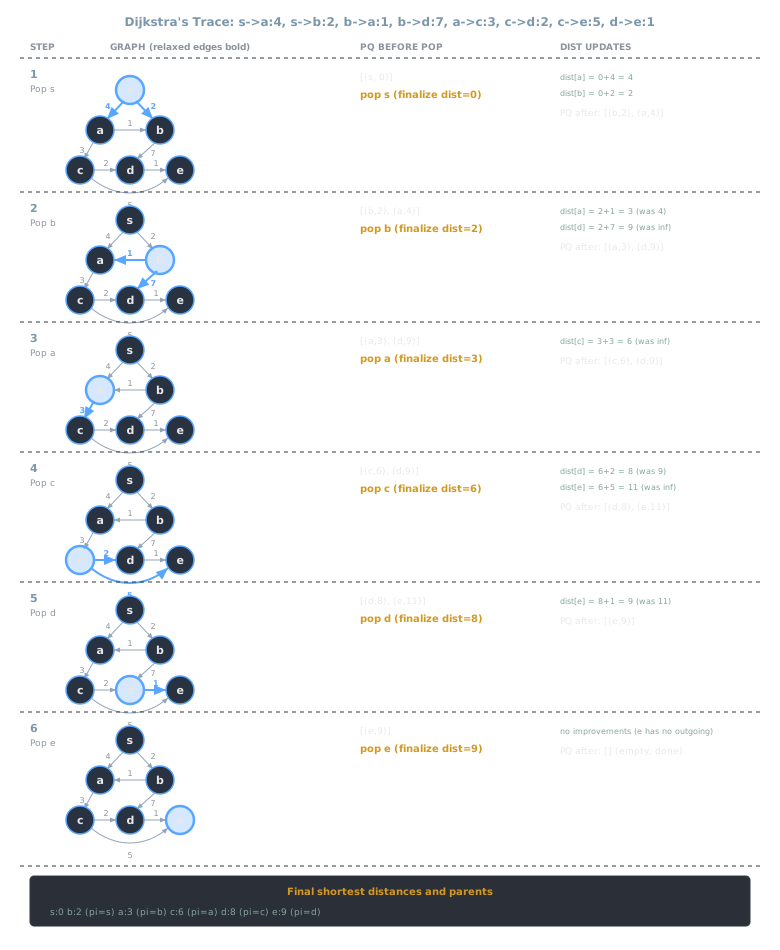
s→a:4,s→b:2,a→c:3,b→a:1,b→d:7,c→d:2,c→e:5,d→e:1
-
Init:
dist[s]=0, others∞; PQ=[(s,0)]. -
Pop
s(settled). Relaxs→a(4)→dist[a]=4;s→b(2)→dist[b]=2. PQ=[(b,2),(a,4)]. -
Pop
b(settled at 2). Relaxb→a(1)→dist[a]=3(improved from 4),π[a]=b; relaxb→d(7)→dist[d]=9. PQ now has updated(a,3),(d,9). -
Pop
a(settled at 3). Relaxa→c(3)→dist[c]=6. PQ adds(c,6). -
Pop
c(6). Relaxc→d(2)→dist[d]=8(improved from 9);c→e(5)→dist[e]=11. -
Pop
d(8). Relaxd→e(1)→dist[e]=9(improved from 11) withπ[e]=d. -
Pop
e(9). Done. Parents define shortest-path tree.
Complexity Analysis
Let n = |V|, m = |E|.
-
With a binary heap: each
extract_minisO(log n)(≤ntimes), each successful relaxation does adecrease_keyO(log n)(≤mtimes). Time:O((n + m) log n). Space:O(n). -
With a d-ary heap:
extract_min = O(d log_d n),decrease_key = O(log_d n). Choosedto balance operations (see D-ary Heap). -
With Fibonacci / pairing heaps (amortized): Time:
O(m + n log n)due toO(1)amortizeddecrease_key. -
Dense graphs with adjacency matrix:
O(n^2)array-scan version (no PQ) is competitive whenm ≈ n^2.
Optimizations or Variants
-
Early exit: If only the distance to a target
tis required, stop whentis popped (settled). -
Edge bucketing: For integer weights in
[0..C], use buckets (Dial’s algorithm) to getO(m + nC)or radix-heap variants forO(m log C + n log C). -
0-1 BFS: If weights are only
0or1, a deque yieldsO(n + m)(special case distinct from general Dijkstra). -
Bidirectional Dijkstra: Run forward from
sand backward fromt; meet in the middle to reduce explored region (requires consistent potentials for directed graphs). -
Heuristic potentials: With feasible potentials
h(no negative reduced weights), Dijkstra on reduced costs supports A*-like search (still needs non-negative reduced edges).
Applications
-
Routing / navigation on road networks (non-negative travel times).
-
Network planning: least-cost trees when costs are additive and non-negative.
-
Scheduling / project planning where tasks have non-negative durations and dependencies.
-
As a subroutine: in Johnson’s algorithm for all-pairs on sparse graphs with reweighted non-negative edges.
Common Pitfalls or Edge Cases
Warning
Negative edges. Any negative edge invalidates the greedy choice. Use Bellman–Ford or Johnson’s reweighting before Dijkstra.
Warning
Visited too early. Do not mark a vertex “visited” on discovery. Only treat it as settled when it is popped from the PQ; otherwise improvements get ignored.
Warning
Decrease-key vs push-many. If you mix patterns (e.g., mark visited on discovery and push-many), you can finalize a suboptimal distance. Stick to one consistent pattern.
Warning
Zero-weight edges. Allowed; they can create many ties. Ensure the PQ handles equal keys deterministically and that push-many skips stale entries.
Warning
Overflow & infinity. Use sufficiently wide numeric types; initialize
∞to a sentinel larger than any reachable distance.
Implementation Notes or Trade-offs
-
PQ choice: Binary heap is simple and fast in practice; d-ary heaps (e.g.,
d=4or8) can reduce height and speeddecrease_key-heavy workloads; Fibonacci/pairing heaps favor extremely manydecrease_keyoperations. -
Graph storage: Use adjacency lists for sparse graphs to achieve
O(m log n)complexity. -
Parent recovery: Store
π[v]on each improvement to rebuild shortest paths. If multiple equal shortest paths exist, tie-break consistently for stable trees. -
Unreachable vertices: Leave
dist=∞andπ=NIL; they never enterS.
Summary
Dijkstra’s algorithm grows a settled set outward from the source, always expanding the smallest tentative distance next. With non-negative edges, each pop finalizes a vertex’s distance. Efficient implementations hinge on a consistent PQ strategy (decrease-key or push-many), proper relaxation, and a data structure tuned to graph density and workload.