Overview
A suffix trie stores every suffix of a string S in a trie, so that every substring of S appears as a path from the root. This makes substring queries straightforward - walk the pattern’s characters from the root and test if the path exists. The simplicity is attractive for teaching and small inputs, but the structure is space-heavy: a naive suffix trie has Θ(n²) nodes and edges in the worst case for a length-n string, which limits practical use. For large texts, compressed variants (suffix trees) and array-based indices (suffix arrays/LCP) are preferred.
Note
Always append a unique end marker (e.g.,
$not present inS) so every suffix ends at a distinct terminal; this avoids ambiguity and ensures thatSitself is represented.
Structure Definition
A suffix trie is an uncompressed trie over the set:
Suffixes(S) = { S[i..n] : i ∈ [0..n] } // include the empty suffix via '$'
Each node stores:
- Children: map from next character to child node.
- Terminal metadata (optional but useful): a list (or bitset) of starting indices where the path leading to this node occurs in
S. For substring queries, store indices at every node reached during insertion of a suffix (occurrence posting lists).
Common representations:
- Array children for tiny alphabets (e.g., DNA); hash/ordered map for general text.
- Per-node positions:
- Minimal: only mark terminal of each suffix with its starting index
i. - Rich: at every node store positions where the node’s path occurs (supports substring → occurrences directly).
- Minimal: only mark terminal of each suffix with its starting index
Tip
For teaching, store positions only at terminal suffix nodes and derive substring positions by following the query path and then collecting all suffix terminals reachable below it. For efficiency, many implementations store positions at each node during insertion.
Core Operations
Build (naive)
Insert each suffix S[i..n] into the trie, character by character, ending with $.
function BUILD_SUFFIX_TRIE(S):
    S = S + '$'                     // unique end marker
    root = new Node()
    for i in 0..|S|-1:              // start at every position
        node = root
        for j in i..|S|-1:
            c = S[j]
            if node.children lacks c:
                node.children[c] = new Node()
            node = node.children[c]
            // Optional: record occurrence of the current prefix
            node.positions.add(i)   // substring S[i..j] occurs starting at i
    return root
Space/time: Θ(n²) inserts, Θ(n²) edges in the worst case.
Substring existence
Check if pattern P is a path from the root.
function CONTAINS(root, P) -> bool:
    node = root
    for c in P:
        if node.children lacks c: return false
        node = node.children[c]
    return true
Find all occurrences
If positions were recorded per node during build, return them directly. Otherwise, descend by P, then collect starting indices from all suffix-terminal descendants.
function OCCURRENCES(root, P) -> list<int>:
    node = root
    for c in P:
        if node.children lacks c: return []     // not found
        node = node.children[c]
    if node.positions exists:
        return node.positions                   // O(|P|) + output
    else:
        return collectSuffixStarts(node)        // DFS to leaves with '$'
Longest repeated substring (sketch)
Walk the trie; the deepest node with subtree size ≥ 2 (distinct starting indices) yields a longest repeated substring. This is simpler on suffix trees due to compression.
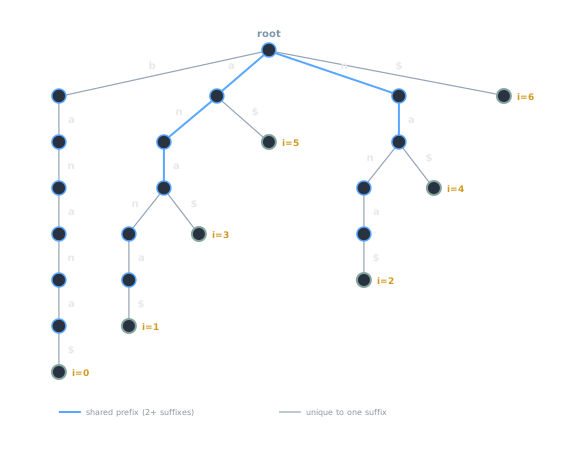
![Querying "ana" in the suffix trie: follow edges a→n→a to find positions [1, 3]](../../cs/dsa/assets/suffix-query-trace.svg)
Example (Stepwise)
Let S = "banana". Append $: banana$. Insert each suffix:
-
banana$ -
anana$ -
nana$ -
ana$ -
na$ -
a$ -
$
As these are inserted, shared prefixes (like a→n→a) merge. Now:
-
CONTAINS("nan")→ true (pathn→a→nexists). -
OCCURRENCES("ana")→[1, 3](depending on how you stored positions). -
CONTAINS("band")→ false at edgedmissing underban.
Note
Because every suffix is present, every substring appears as a prefix of some suffix and thus as a path from the root.
Complexity and Performance
Let n = |S| and m = |P|.
-
Build:
Θ(n²)time and space in the worst case (e.g., all characters identical). Even for random text, size is usually large. -
Substring existence:
Θ(m)time (path walk), independent ofn. -
Occurrences:
Θ(m + k)wherekis the number of matches if positions are stored per node; otherwise add the cost of a subtree traversal to collect suffix terminals. -
Memory: Dominated by nodes/edges. With alphabet
σ, a naive array-child implementation costsΘ(σ)pointers per node - prohibitive for largeσ.
Why compression helps: A suffix tree compresses chains of single-child nodes into edge labels (substrings), reducing size to Θ(n) nodes/edges and enabling linear-time builds (e.g., Ukkonen). Suffix arrays plus LCP achieve Θ(n) or Θ(n log n) build with excellent memory locality.
Warning
A naive suffix trie is not suitable for large inputs. Treat it as a didactic structure or a practical choice only for small strings and tiny alphabets.
Implementation Details or Trade-offs
-
Alphabet & encoding: Choose UTF-8/16-aware iteration if
Sis Unicode. It’s usually best to index by code points (or even grapheme clusters for UI), not raw bytes. See Strings. -
End marker: Ensure
$(or chosen sentinel) is not in the alphabet; otherwise, escape or reserve a unique code point. -
Positions storage:
-
Per-node lists: Fast queries; memory heavy (store many duplicates).
-
Leaf-only indices: Store only at suffix ends; for substring occurrences, descend to
Pthen collect leaf indices (slower but lighter). -
Compressed postings: Use sorted vectors with delta encoding; maintain de-duplicated sets to avoid quadratic blow-ups on repeated substrings.
-
-
Children representation:
-
Hash maps give average
O(1)step with lower memory than fixed arrays. -
Ordered maps (trees) support lexicographic enumeration at the cost of
O(log d)per step (d= degree).
-
-
Arenas/pools: Allocate nodes in a memory pool to improve locality and reduce allocator overhead.
-
Hybrid approach: Start with a suffix trie for clarity; when
ngrows past a threshold (or node count explodes), migrate to a suffix tree/array.
Tip
For teaching or prototyping substring search, build a suffix trie only for a sliding window of recent text, or for a dictionary of modest size; switch to suffix arrays/trees for scale.
Practical Use Cases
-
Didactic tool: illustrate why every substring is a path and motivate compression into suffix trees.
-
Small dictionaries: quick prefix/substring search across a few thousand keys.
-
Pattern lab: compare behaviors of tries, compressed tries, suffix tries/trees, and arrays on the same
S.
Limitations / Pitfalls
Warning
Quadratic size. Worst-case
Θ(n²)nodes/edges; memory explodes quickly. Use suffix trees/arrays for production.
Warning
Redundant positions. Storing positions at every node duplicates information across many nodes; compress or compute on demand.
Warning
Large alphabets. Fixed-size child arrays per node are untenable; use maps and consider path compression.
Warning
Unicode boundaries. Building over bytes can split code points; normalize and iterate by code point if string semantics matter.
Summary
A suffix trie indexes all suffixes of S, making substring queries conceptually trivial: match the pattern as a path from the root. Its simplicity brings clear query-time benefits (Θ(m)), but the space cost is quadratic in the worst case, and constant factors are high. As a result, suffix tries are best seen as a teaching or small-scale structure that motivates efficient suffix trees (path-compressed) and suffix arrays (compact, cache-friendly). When you need scalability, compress; when you need clarity, the suffix trie is a good starting point.