Overview
A standard trie (a.k.a. prefix tree) stores strings so that each edge corresponds to a character and each root-to-node path spells a prefix of some key. Tries provide prefix-friendly lookup: exact membership, prefix queries, and lexicographic iteration in time proportional to the length of the query, not the number of stored keys. The trade-off is memory: naive node designs allocate a child slot per alphabet symbol, which can be expensive on large alphabets or sparse branches.
Note
A “standard trie” here means uncompressed—every character consumes one edge. For space-optimized variants see Compressed Trie and for substring indexing see Suffix Trie.
Structure Definition
Each node represents a prefix p. It stores:
- Children: a mapping from next character
cto the child node for prefixp·c. - Terminal flag:
isWordindicating whetherpis a complete key. - Optional payload: counts, values, or end-of-word metadata (e.g., frequency for autocomplete).
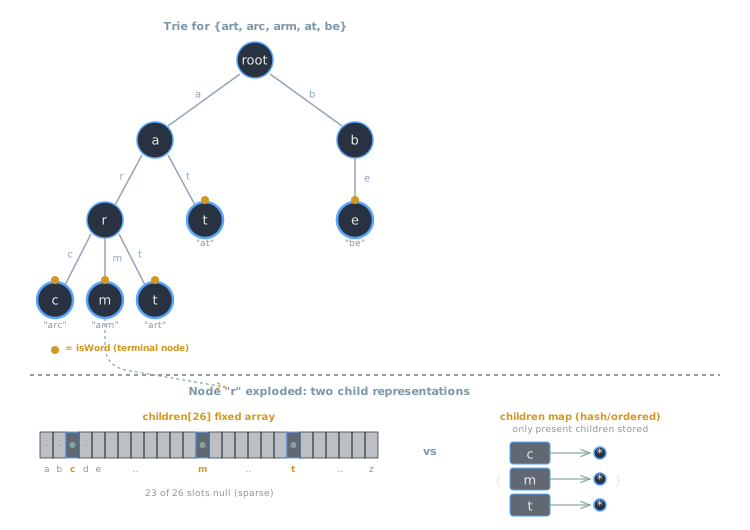
Two common child representations:
-
Fixed array of size
|Σ|(alphabet):children[σ]pointers indexed by character code.- Fast and cache-friendly on small alphabets (e.g., lowercase English, DNA).
- Wastes memory when branching is sparse or
|Σ|is large (Unicode).
-
Dictionary/map (hash map or ordered map):
- Stores only present children.
- Space-efficient and flexible with large or sparse alphabets.
- Slightly higher per-step constant factors than arrays.
Tip
Use arrays for tiny alphabets (e.g.,
Σ = {a..z}), and maps for large or unknown alphabets. A hybrid that switches from array→map at low degree can balance speed and memory.
Core Operations
Assume A[i] yields the i-th character and |s| is string length.
Insert
function INSERT(root, s):
    node = root
    for i in 0..|s|-1:
        c = s[i]
        if node.children lacks c:
            node.children[c] = new Node()
        node = node.children[c]
    node.isWord = true
Search (exact key)
function SEARCH(root, s) -> bool:
    node = root
    for i in 0..|s|-1:
        c = s[i]
        if node.children lacks c: return false
        node = node.children[c]
    return node.isWord
Starts-with / Prefix probe
function STARTS_WITH(root, prefix) -> bool:
    node = root
    for c in prefix:
        if node.children lacks c: return false
        node = node.children[c]
    return true   // reached the node for 'prefix'
Delete (unmark + prune)
function DELETE(root, s) -> bool:
    // returns true if a node can be pruned up the call
    function RECUR(node, i) -> bool:
        if i == |s|:
            if not node.isWord: return false
            node.isWord = false
            return node.children is empty
        c = s[i]
        if node.children lacks c: return false
        canPrune = RECUR(node.children[c], i+1)
        if canPrune:
            remove node.children[c]
        return (not node.isWord) and node.children is empty

    return RECUR(root, 0)
Enumerate by prefix (autocomplete)
Depth-first iterate from the node reached by prefix, yielding all words under it in lexicographic order (if children are ordered).
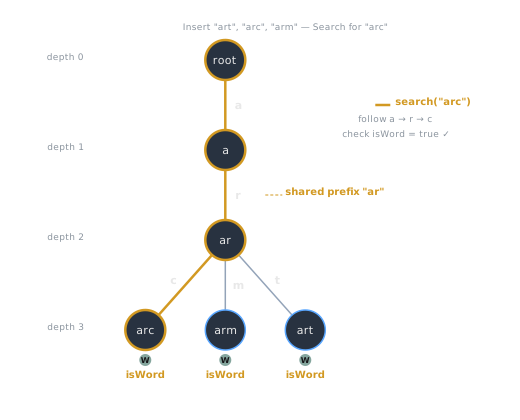
Example (Stepwise)
Suppose keys: art, arc, arm, at, be.
-
Insert
art: create nodes alonga→r→t, setisWordatt. -
Insert
arc/arm: sharea→r, branch atcandm. -
Insert
at: reusea, createtundera, setisWord. -
Insert
be: create newb→ebranch from root.
-
SEARCH("arc")succeeds: path exists andisWord=true. -
STARTS_WITH("ar")succeeds even thougharisn’t a word; it is a prefix node. -
DELETE("arm")unmarksisWordatmand prunes themnode if it now has no children.
Complexity and Performance
Let n be the number of stored keys, L the average key length, and k = |s| the query length.
-
Insert / Search (exact) / Starts-with:
Θ(k)time; depends only on query length, not onn.
With array children, each character step isO(1); with map children, each step isO(1)expected (hash) orO(log d)for ordered maps wheredis node degree. -
Delete:
Θ(k)for traversal plus pruning on the path back (bounded byk). -
Space:
Θ(Σ nodes + Σ edges); worst caseΘ(n·L)pointers plus node headers. With arrays, multiply by|Σ|; with maps, proportional to nonempty children plus map overhead.
Cache and constants:
-
Array child pointers give predictable, branch-light traversal with good locality on small
|Σ|. -
Hash-map children add indirection and hashing but save memory when branching is sparse.
-
Ordered maps enable lexicographic traversal without extra sorting.
Warning
Memory blow-up on large alphabets. An array of size
|Σ|per node becomes prohibitive for Unicode or mixed symbol sets. Prefer dictionary children or adopt Compressed Trie.
Optimizations or Variants
Node representation
-
Tagged union: Start nodes as a tiny dictionary; upgrade to an array once degree exceeds a threshold (e.g., 4–8). This captures array speed on dense nodes and map economy on sparse nodes.
-
Bitset + compact edge list: For small fixed alphabets, track a presence bitset and a packed child vector; compute indices with
rank(bitset, c).
Path compression (radix tree)
Merge chains of single-child nodes so edges carry strings instead of single characters. This reduces height and memory; see Compressed Trie for details.
End-of-word payloads
Store per-word metadata at terminal nodes:
-
Frequencies for ranking autocomplete suggestions.
-
Document/posting lists for inverted indexes.
-
Values for dictionary maps (key→value).
Case & normalization
Normalize input at insert/search time:
-
Choose case folding policy (e.g., lowercase).
-
Normalize Unicode (NFC/NFKC) to canonicalize equivalent strings.
-
Strip/standardize punctuation as needed for the application.
Iteration & ordering
-
With ordered maps or arrays, a simple DFS yields lexicographic order for free.
-
With hash maps, maintain a lightweight sorted index per node if lexicographic iteration is required.
Space reductions
-
Shared suffix pooling is not typical for tries (prefix-oriented), but DAWG (directed acyclic word graph) merges isomorphic suffix subtrees for large lexicons.
-
Pointer compression: store child offsets in a contiguous node arena and encode small offsets with fewer bytes.
Applications
-
Autocomplete & prefix search: fast
STARTS_WITHqueries with top-k enumeration by walking a subtree and ranking by stored frequencies. -
Spell-checking: near-neighbor search (edits at small Levenshtein distance) prunes by prefix mismatch.
-
Routing & command trees: structured command parsing (
git chec…) and URL routing by segments (trie over tokens). -
Dictionary maps (string keys): exact membership and value retrieval with predictable
Θ(k)latency, independent ofn. -
Security/log analysis: blocklists/allowlists where early prefix mismatch yields immediate rejection.
Common Pitfalls or Edge Cases
Warning
Alphabet mismatch. Inconsistent encoding (ASCII vs UTF-8 vs UTF-16) breaks indexing; normalize input and use a well-defined alphabet mapping from code points to child indices/keys.
Warning
Terminal flag confusion. A node can be both a word and a prefix (e.g.,
atvsatom). Never inferisWordfrom “leafness”.
Warning
Delete semantics. Removing a word should unmark
isWordand prune only if the node has no children andisWord=false. Over-eager pruning can delete valid longer words sharing the prefix.
Warning
Memory hotspots. Storing big payloads at every terminal node inflates memory. Keep payloads minimal (IDs, counts) and store large objects externally.
Warning
Locale & normalization bugs. Case folding and Unicode normalization can map multiple spellings to the same path or vice versa; define policies upfront and apply them consistently on both insert and query.
Implementation Notes or Trade-offs
-
Map choice:
-
Arrays: best constants on tiny alphabets; require dense usage to justify cost.
-
Hash maps: average
O(1)step, robust with large or variable alphabets. -
Ordered maps: enable sorted iteration without extra structures;
O(log d)per step.
-
-
Memory layout:
-
Node arenas/pools avoid allocator overhead and improve locality.
-
SoA (structure of arrays) layouts can compact child tables for dense nodes.
-
-
Concurrency:
-
Writes (insert/delete) require synchronization; readers can use RCU or epoch reclamation with copy-on-write nodes.
-
For high-QPS read-mostly workloads, build the trie immutably and rebuild off to the side for batch updates.
-
-
Testing:
-
Include keys that are prefixes of others.
-
Verify deletion does not affect supersets/superset prefixes.
-
Fuzz with random Unicode inputs if supporting non-ASCII.
-
Summary
A standard trie offers predictable Θ(k) operations for exact and prefix queries by indexing characters along edges and marking terminal nodes for complete words. It excels at prefix-heavy tasks like autocomplete and routing, trading space for speed and simplicity. Sensible node representations (array vs map), clear normalization policies, and careful delete/pruning logic produce a robust, scalable implementation. For large datasets or long chains of degree-1 nodes, consider Compressed Trie to reduce height and memory while preserving prefix operations.