By the late 1990s the Web had more pages than anyone could index by hand, and matching keywords returned mostly junk. Larry Page and Sergey Brin, at Stanford, had an insight that became Google: the Web’s link structure is itself data you can rank.
The idea
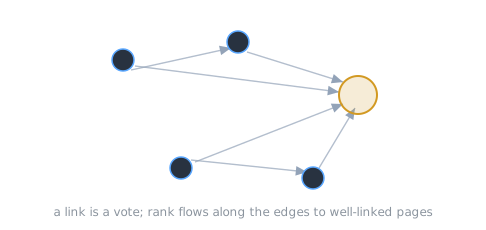
Treat the Web as a directed graph, pages as nodes and links as edges. A link is a vote, and a vote from an important page counts for more. Rank pages by this recursive importance and the good ones rise to the top.
Links as votes
Page and Brin developed PageRank at Stanford in 1996. A hyperlink to a page counts as a vote of support, and a page’s rank depends on both the number and the rank of the pages that link to it. The definition is recursive: to know how important a page is, you need to know how important the pages pointing at it are.
The mathematics
That recursive definition has a clean solution. The PageRank values are the entries of the dominant eigenvector of the link matrix, rescaled so each column sums to one. Equivalently, picture a random surfer who clicks links forever and occasionally jumps to a random page; a page’s rank is the long-run probability the surfer is on it. Eigenvector and random walk are two views of the same answer.
Why it matters
Ranking by structure rather than keywords made web search genuinely useful, and it is a clean case of turning a real-world network into linear algebra. The same idea, the dominant eigenvector of a graph, recurs throughout computer science wherever importance flows along connections.
Related Notes
- Graphs, the structure PageRank operates on
- Linear Algebra Fundamentals, the eigenvector behind it
- The World Wide Web, the graph being ranked
- Hash Tables, part of how a search index is built
- History of Computing, the section index
Sources
- “PageRank,” Wikipedia. https://en.wikipedia.org/wiki/PageRank . Supports PageRank’s development by Larry Page and Sergey Brin at Stanford in 1996, the treatment of a hyperlink as a vote with rank defined recursively, and the mathematical characterization as the dominant eigenvector of the rescaled link matrix, equivalent to a random-surfer model.