A computer needs a reason to buy it. For the early personal computer, that reason turned out to be the spreadsheet. VisiCalc, released in 1979, was so useful that people bought a whole computer just to run it, the first time software sold the hardware.
The idea
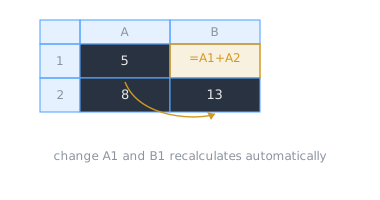
A grid of cells, where each cell holds a value or a formula that refers to other cells, and the program automatically recalculates everything that depends on a value the moment it changes. It is a small declarative dataflow language that anyone can use without knowing they are programming.
The first spreadsheet
VisiCalc was the first spreadsheet program for personal computers, released for the Apple II on 17 October 1979. It presented a sheet of cells that, as one description put it, could perform calculations and recalculations so the user could just solve a problem with familiar tools.
The killer app
It is often called the first killer application, the software that turned the microcomputer from a hobbyist’s toy into a serious business tool. Businessmen who saw it in a store wanted it at once, and more than a quarter of Apple IIs sold in 1979 were reportedly bought in order to run it.
Why it matters
VisiCalc proved that software could drive hardware sales, which reshaped the whole industry’s logic. And the dependency-recalculation model it introduced, change one cell and everything downstream updates, is still exactly how every spreadsheet works, a quietly profound idea hiding in an everyday tool.
Related Notes
- The Altair 8800 and the Personal Computer, the hardware VisiCalc sold
- Programming Paradigms, where the dataflow model fits
- History of Computing, the section index
Sources
- “VisiCalc,” Wikipedia. https://en.wikipedia.org/wiki/VisiCalc . Supports VisiCalc as the first spreadsheet program for personal computers, released for the Apple II on 17 October 1979, considered the killer application that turned the microcomputer into a business tool, its automatic recalculation, and its role driving Apple II sales.