Engelbart showed what interactive computing could be. Xerox PARC built the machine that made it a product. The Xerox Alto of 1973 united a bitmapped screen, a mouse, and overlapping windows into the first practical graphical user interface.
The idea
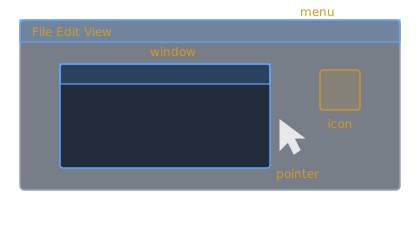
The WIMP interface: windows, icons, menus, and a pointer, on a bitmapped display where every pixel is addressable. The screen becomes a direct visual workspace instead of a scroll of text.
The Alto
Developed at Xerox PARC and first introduced on 1 March 1973, the Alto pioneered the graphical user interface, the computer mouse, and a bit-mapped display, and it was designed around a GUI using the desktop metaphor. For the first time, a screen showed a workspace you could point at and manipulate directly.
From PARC to the world
In 1979 Steve Jobs visited Xerox PARC, and after seeing the Alto, Apple engineers used its concepts in developing the Lisa and the Macintosh. The interface on nearly every screen today, phone or laptop, descends from this one research machine.
Why it matters
The graphical interface made computers usable by people who were not programmers. That was the precondition for the personal computer to become a mass tool rather than a hobbyist’s kit, and for software like the spreadsheet to reach everyone.
Related Notes
- Engelbart and the Mother of All Demos, the ideas PARC built on
- The Altair 8800 and the Personal Computer, the hardware side of the revolution
- Von Neumann Architecture, the machine beneath the interface
- History of Computing, the section index
Sources
- “Xerox Alto,” Wikipedia. https://en.wikipedia.org/wiki/Xerox_Alto . Supports the Alto’s development at Xerox PARC and introduction on 1 March 1973, its pioneering of the graphical user interface, the mouse, and a bit-mapped display using the desktop metaphor, and Steve Jobs’s 1979 visit leading Apple to use the concepts in the Lisa and Macintosh.