Overview
Every programming language must define what variables mean: how they acquire values, where those values live, and how their bindings evolve during execution.
The trio of values, variables, and environments forms the backbone of this model.
In the λ-calculus, variables were abstract placeholders. In real programming languages, they correspond to names, memory locations, and runtime values, linked together through an environment.
Note
Understanding environments is central to interpreting programs and implementing interpreters or compilers.
They provide the mapping from identifiers → values (or locations), grounding abstract syntax in runtime behavior.
Expressions, Values, and Variables
Expressions
Expressions represent computations. They are evaluated in some context (an environment) to produce values.
3 + 4 -- expression
(x * 2) + 5 -- expression involving a variable
Values
Values are the results of evaluation: things that can no longer be simplified (in pure languages).
Examples include:
- Integers (
5) - Booleans (
true) - Functions (
λx. x + 1) - Compound data (
(1, 2))
Values are often treated as self-evaluating:
⟦5⟧ρ = 5
Variables
Variables are names bound to values or memory locations.
They have no inherent meaning until evaluated in an environment:
⟦x⟧ρ = ρ(x)
If x is not in the domain of ρ, the variable is unbound → runtime error.
Tip
The key distinction: expressions describe computation, values describe results, variables describe places to look for those results.
Environments (ρ)
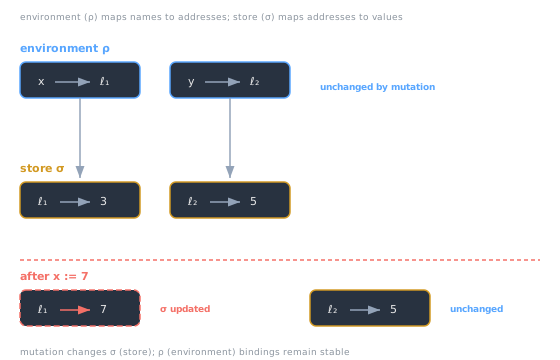
An environment is a mapping from variable names to values or locations.
Formally:
ρ : Identifier → Value
or, in the case of mutable languages:
ρ : Identifier → Location
σ : Location → Value
Here:
ρ(rho): the environment, records bindings (name → location).σ(sigma): the store, records contents (location → value).
Together, they describe the state of a program.
Note
Many interpreters use environments for scoping and stores for mutation.
This separation cleanly models both immutable and mutable variables.
Example: Immutable Language (Functional)
In a pure functional language:
let x = 3 in x + 2
Evaluation proceeds as:
- Extend environment:
ρ' = ρ[x ↦ 3]
- Evaluate body
x + 2under ρ′:
⟦x + 2⟧ρ' = 5
No store is needed; bindings are directly immutable associations.
Example: Mutable Language (Imperative)
In an imperative setting:
var x = 3;
x = x + 2;
we use both ρ and σ:
- Allocate a new location
l1.
ρ' = ρ[x ↦ l1]
σ' = σ[l1 ↦ 3]
- Update:
σ'' = σ'[l1 ↦ 5]
Now:
⟦x⟧ρ'σ'' = σ''(ρ'(x)) = σ''(l1) = 5
Nested and Lexical Environments
Block Scope
When a new block introduces local bindings:
let x = 10 in
let y = x + 2 in
y * 3
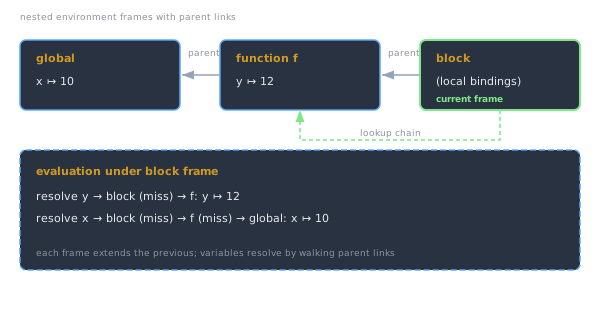
each block creates a new environment frame extending the previous:
ρ0 = {}
ρ1 = ρ0[x ↦ 10]
ρ2 = ρ1[y ↦ 12]
Evaluating under ρ2, the variable x still resolves through ρ1: lexical scoping.
Lexical vs Dynamic Scope
- Lexical (static): variable binding determined by the program’s structure.
Most modern languages (Python, C, Haskell) use lexical scope. - Dynamic: variable binding determined by the call stack at runtime (old Lisp, shell scripts).
Warning
Dynamic scope makes reasoning difficult: a variable’s value may depend on the call history rather than the code’s textual layout.
Closures: Functions with Environments
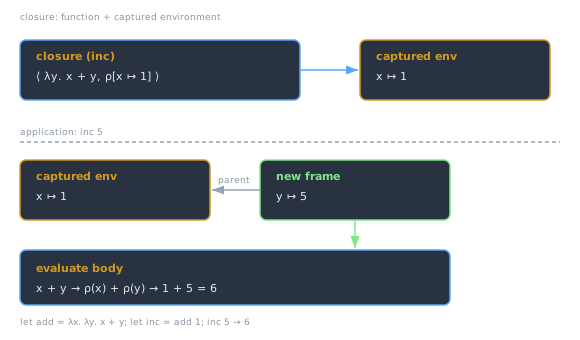
A closure pairs a function with the environment that existed when it was defined.
Example
let add = λx. λy. x + y
let inc = add 1
inc 5
During add 1, the inner λy. x + y forms a closure:
⟦add 1⟧ρ = ⟨λy. x + y, ρ[x ↦ 1]⟩
When inc 5 executes:
- Environment
ρ[x ↦ 1]is used. - Argument
y = 5extends it temporarily. - The body computes
x + y = 6.
Tip
Closures are how functional languages implement lexical scope: functions carry their own environment.
Formal Notation Recap
| Concept | Symbol | Meaning |
|---|---|---|
| Environment | ρ | name → location (or value) |
| Store | σ | location → value |
| Expression evaluation | ⟦E⟧ρ,σ | evaluate E in ρ, σ |
| Binding extension | ρ[x ↦ v] | new mapping |
| Lookup | ρ(x) | value or location bound to x |
Note
Many semantics textbooks use
Env,Store, andValdomains with similar notations:Env = Id → Loc Store = Loc → Val Val = Int + Bool + (Loc → Loc) + ...
Environments in Interpreter Design
A basic interpreter can model environment behavior explicitly:
def eval_expr(expr, env):
    if isinstance(expr, int):
        return expr
    elif isinstance(expr, str):
        return env[expr]
    elif isinstance(expr, list) and expr[0] == "let":
        _, x, e1, e2 = expr
        v1 = eval_expr(e1, env)
        new_env = env.copy()
        new_env[x] = v1
        return eval_expr(e2, new_env)
Mutable variants add a store object and store references instead of direct values.
Tip
This dual model (
env,store) is the practical analog of ρ and σ, used in compilers, interpreters, and operational semantics.
Shadowing and Lifetime
When a new variable shadows an old one:
let x = 1 in
  let x = 2 in
    x + 3
we extend the environment with a new binding:
ρ0[x ↦ 1]
ρ1 = ρ0[x ↦ 2]
The previous binding is not destroyed; it just becomes inaccessible.
Once the inner block exits, ρ1 is discarded and ρ0 resumes.
Note
This stack-like environment chain models lifetime and scope without mutating outer bindings.
Mutation and Shared State
Languages with mutable variables maintain persistent environment bindings and mutate store entries instead.
Example:
var x = 0;
function f() { x = x + 1; }
f(); f();
After var x = 0:
ρ[x ↦ l1]
σ[l1 ↦ 0]
Each call to f performs:
σ[l1 ↦ σ(l1) + 1]
After two calls: σ[l1] = 2.
Warning
Mutation blurs the line between lexical scope and dynamic behavior: functions may share state via the same store entries.
Environments and Recursive Bindings
Recursion requires self-reference: a function must see its own binding during definition.
let rec fact = λn. if n == 0 then 1 else n * fact (n-1)
To support this:
-
Allocate a location
l. -
Extend ρ before evaluating the definition:
ρ' = ρ[fact ↦ l] -
Evaluate body under
ρ'to form a closure capturingρ'. -
Store closure in σ:
σ[l ↦ ⟨λn. ..., ρ'⟩]
Note
Recursive environments require circular structures: the closure points back to the environment that contains it.
Dynamic Extensions: Activation Records
During execution, each function call creates a new environment frame, often represented as an activation record on the stack.
When a call returns, the frame is popped, restoring the previous ρ.
Languages with first-class functions store environments on the heap (to allow returning closures), while stack-based languages reclaim them after return.
Static vs Dynamic Environments
| Concept | Static (Compile-Time) | Dynamic (Run-Time) |
|---|---|---|
| Binding | Symbol table | Environment ρ |
| Value resolution | Determined by lexical structure | Determined by runtime chain |
| Lifetime | Scope rules | Activation record duration |
Tip
The symbol table at compile time predicts what ρ will look like at runtime.
Conceptual Summary
| Layer | Concept | Description |
|---|---|---|
| Syntactic | Expression, Variable | Abstract code form |
| Semantic | Value | Result of evaluation |
| Operational | Environment (ρ), Store (σ) | Concrete model of name–value linkage |
| Implementation | Stack, Heap | Real machine-level mapping |
Together, they form the conceptual bridge from syntax to execution.
Note
The model is general: functional, imperative, and object-oriented languages all differ mainly in how they structure environments and manage stores.
See also
Sources
- “Variable (computer science),” Wikipedia. https://en.wikipedia.org/wiki/Variable_%28computer_science%29 . Supports a variable as a symbolic name paired with a storage or indirection location that holds a value, grounding the name-to-location-to-value model.
- “Scope (computer science),” Wikipedia. https://en.wikipedia.org/wiki/Scope_%28computer_science%29 . Supports the notion of a name binding being valid within a region of a program, and the distinction between lexical (static) and dynamic scope.
- “Closure (computer programming),” Wikipedia. https://en.wikipedia.org/wiki/Closure_%28computer_programming%29 . Supports a closure as a record pairing a function with an environment that maps its free variables, used to implement lexically scoped binding with first-class functions.