Overview
Pure functional languages describe computation as expression → value mappings, independent of time or state.
However, real-world programming requires mutation: variables that change, data that updates, and effects that persist.
To reason about this, programming languages extend their semantics with locations and a store (σ).
Note
Mutable state introduces time into semantics: expressions no longer evaluate to a single value, but to a value and a new store.
Core Concepts
Values, Locations, and the Store
- Values: immutable entities (integers, booleans, closures).
- Locations (ℓ): addresses in memory where values reside.
- Store (σ): mapping of locations to values:
σ : Location → Value
When an expression mutates state, it returns both a result and a new store:
⟨e, σ⟩ ⇓ ⟨v, σ'⟩
Motivation
Mutable state allows:
- Persistent data (e.g., object fields, variables, arrays)
- Efficient algorithms (in-place updates)
- Controlled I/O and interaction
- Sequencing of dependent computations
But it also introduces:
- Aliasing: multiple references to the same location.
- Order dependence: evaluation results depend on timing.
Syntax
We extend the λ-calculus with reference primitives:
t ::= ...
| ref t -- allocate reference
| !t -- dereference
| t1 := t2 -- assignment
| t1 ; t2 -- sequencing
Informal Behavior
| Construct | Meaning | Example |
|---|---|---|
ref t | allocate a new location containing t | let x = ref 5 |
!t | read the value stored in the location | !x → 5 |
t1 := t2 | update location from t1 with value of t2 | x := 7 |
t1 ; t2 | sequence: evaluate t1, then t2 | x := 3; !x |
Tip
The sequencing operator
;explicitly orders effects, ensuring thatt1is evaluated beforet2.
Operational Semantics
Small-step rules capture how state evolves step by step.
Allocation
⟨ref v, σ⟩ → ⟨ℓ, σ[ℓ ↦ v]⟩ (ℓ fresh)
ref vallocates a new locationℓ.- The store is extended with a mapping from
ℓtov.
Dereference
⟨!ℓ, σ⟩ → ⟨σ(ℓ), σ⟩
- Reading a reference returns the stored value, leaving the store unchanged.
Assignment
⟨ℓ := v, σ⟩ → ⟨unit, σ[ℓ ↦ v]⟩
- Updates the existing mapping at
ℓ. - Returns a
unitvalue to indicate sequencing, not computation.
Sequencing
⟨t1 ; t2, σ⟩ → ⟨t1', σ'⟩ ; t2
until t1 reduces to unit, then continue with t2.
Example
Diagram idea (
store_evolution.svg)
Show σ as a table evolving from{}→{ℓ1: 5}→{ℓ1: 7}as evaluation proceeds:let r = ref 5 in r := 7; !r
Example Walkthrough
Consider:
let x = ref 0 in
x := !x + 1;
!x
Step-by-step:
-
ref 0allocates ℓ₁, σ₁ = {ℓ₁ ↦ 0}. -
!xreads σ₁(ℓ₁) = 0. -
x := 0 + 1updates σ₂ = {ℓ₁ ↦ 1}. -
!xnow reads σ₂(ℓ₁) = 1.
Final result:
⟨!x, σ₂⟩ ⇓ ⟨1, σ₂⟩
Tip
This pattern (read, modify, write) is fundamental in imperative programming.
In semantics, it manifests as store-passing between expressions.
Aliasing
Two variables can reference the same location.
Changing one affects the other.
Example
let a = ref 0 in
let b = a in
b := 5;
!a
Result:
⟨!a, σ'⟩ ⇓ ⟨5, σ'⟩
because both a and b point to the same ℓ.
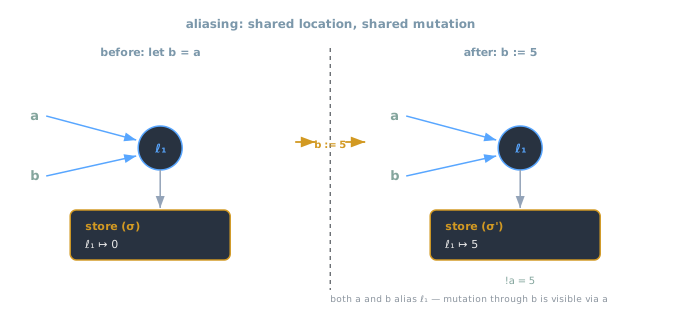
Aliasing is powerful but dangerous: it couples parts of a program through shared state.
Optimizations and reasoning become harder because order now matters.
Side Effects and Sequencing
Sequential Composition
t1 ; t2
ensures t1 executes before t2, even if t1 returns no useful value.
Example
x := 1;
print (!x);
x := !x + 1;
Each step mutates the shared store.
Effects compose through time, not through function return values.
Tip
Effects break referential transparency: two identical expressions may yield different results depending on σ.
Referential Transparency and Effects
| Expression | Without Effects | With Effects |
|---|---|---|
let y = 1 + 1 | always 2 | always 2 |
let y = ref 1 | immutable | allocates new memory |
!r | same result for same r | may differ if store changes |
A pure function f(x) always yields the same result for the same input.
With mutable state, the meaning depends on σ, the state of the world.
Warning
Mutation makes equational reasoning (substitution, simplification) invalid unless effects are controlled or isolated.
Modeling State Formally
We now evaluate expressions as store-transforming computations:
⟦t⟧ : Store → (Value × Store)
In λ-calculus terms, this means:
⟦ref t⟧ σ = let (v, σ') = ⟦t⟧ σ in (ℓ, σ'[ℓ ↦ v])
and similarly for !t and t1 := t2.
Note
This model is the foundation for monadic state in functional languages like Haskell.
Monadic View (Optional Bridge)
Haskell’s State monad captures store-passing explicitly:
type State σ α = σ -> (α, σ)

ref x       ↦  newRef x
!r          ↦  readRef r
r := v      ↦  writeRef r v
This bridges imperative effects and functional purity, making mutations explicit in type signatures.
Common Pitfalls
Warning
Aliasing: accidental shared references lead to unexpected updates.
Order dependence: swapping statements changes meaning.
Memory leaks: lost references keep values alive in σ.
Hidden coupling: side effects across modules break modular reasoning.
Diagram Concepts
-
store_evolution.svg: stepwise state updates through evaluation. -
aliasing_effects.svg: shared location aliasing between identifiers. -
sequencing_flow.svg: sequential control flow over time with σ progression.
See also
Sources
- “Reference (computer science),” Wikipedia. https://en.wikipedia.org/wiki/Reference_%28computer_science%29 . Supports a reference as a value enabling indirect access to a datum in memory, and dereferencing as the act of accessing that datum, grounding
ref,!, and:=. - “Side effect (computer science),” Wikipedia. https://en.wikipedia.org/wiki/Side_effect_%28computer_science%29 . Supports a side effect as an observable effect beyond returning a value, such as modifying a non-local or static variable, which is what mutation introduces.
- “Referential transparency,” Wikipedia. https://en.wikipedia.org/wiki/Referential_transparency . Supports referential transparency as the property that a subexpression can be replaced by another with the same value without changing meaning, which mutation can break.
- “Aliasing (computing),” Wikipedia. https://en.wikipedia.org/wiki/Aliasing_%28computing%29 . Supports aliasing as a situation where one memory location is reachable through multiple names, so modifying through one name affects the others.