Artificial intelligence had promised and underdelivered for decades. In 2012 a single result changed that. A deep neural network called AlexNet won a major image-recognition contest by an enormous margin, and the modern era of AI began.
The idea
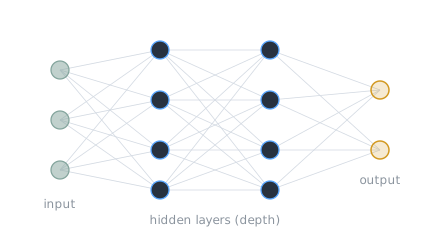
A deep neural network, many layers of simple units, trained on large labeled datasets using fast parallel hardware, can learn features better than humans can hand-engineer them. Depth plus data plus compute beat clever hand-built rules.
AlexNet
Developed in 2012 by Alex Krizhevsky with Ilya Sutskever and Geoffrey Hinton at the University of Toronto, AlexNet was a deep convolutional neural network that won the ImageNet competition with a top-5 error rate of 15.3 percent, more than ten percentage points better than the runner-up. It was trained for about a week on two Nvidia GPUs.
Why GPUs
Training a deep network is a vast amount of linear algebra, multiplying large matrices over and over, which is exactly the parallel arithmetic graphics processors were built for. The decades of hardware scaling had finally made that much computation cheap enough to throw at the problem.
A civilian turning point
Yann LeCun called AlexNet an unequivocal turning point in computer vision. It is distinct from the military funding of AI told in the DARPA note: this was the breakthrough that took AI mainstream and commercial, and it raised the questions of AI governance we are still working through.
Related Notes
- DARPA and the Funding of AI, the earlier, military chapter
- AI Governance, the questions deep learning forced open
- Consciousness: Access vs Phenomenal, whether these systems only process information or could ever feel anything
- Could an LLM Be Conscious?, the live debate over whether a system like this could be a mind
- Linear Algebra Fundamentals, the math a neural net runs on
- Moore’s Law, the cheap compute that made it possible
- History of Computing, the section index
Sources
- “AlexNet,” Wikipedia. https://en.wikipedia.org/wiki/AlexNet . Supports AlexNet as a deep convolutional neural network developed in 2012 by Krizhevsky, Sutskever, and Hinton that won ImageNet with a top-5 error rate of 15.3 percent (more than 10 points above the runner-up), was trained on two Nvidia GPUs, and is regarded as a turning point in computer vision.