Overview
A trie (prefix tree) stores a set or map of strings by laying characters along a path from the root. Keys that share prefixes share nodes, enabling fast prefix queries, lexicographic iteration, and operations like “list all keys with prefix p” in time proportional to |p| + output. Tries trade extra memory for predictable time: lookup, insert, and delete take Θ(L) where L is key length, independent of the number of stored keys n (assuming bounded alphabet and a suitable node representation).
Note
Unlike balanced BSTs or hash tables, the cost of a trie operation depends primarily on characters examined, not on
n. This makes tries attractive when keys are long and share structure, or when prefix functionality is central.
Structure Definition
A trie is a rooted tree where:
- Each edge is labeled by a symbol from an alphabet
Σ(characters, bytes, tokens). - Each node represents a prefix of one or more keys.
- A node may carry a terminal marker (and optionally a value) indicating a complete key ends at that prefix.
Per-node fields commonly include:
children: mapping fromΣto child nodesisTerminal: boolean (or a value/payload for maps)- Optional:
count(# of keys in the subtree),terminalCount(multiset semantics),compressedEdge(for path compression)
Tip
Choose the alphabet carefully (e.g., lowercase ASCII, Unicode code points). Tries are sensitive to
|Σ|; shrinkingΣ(e.g., by normalizing case or tokenizing on bytes) can reduce memory pressure.
Core Operations
Below, Adj[u][c] denotes the child reached from node u by symbol c. Keys are arrays K[0..L-1].
Insert (set or map)
function INSERT(root, K, value?):
    u = root
    for i in 0..L-1:
        c = K[i]
        if Adj[u] lacks c:
            Adj[u][c] = new Node()
        u = Adj[u][c]
        // optional: u.count += 1
    u.isTerminal = true
    if value? provided: u.value = value
Search (exact key)
function CONTAINS(root, K) -> bool:
    u = root
    for i in 0..L-1:
        c = K[i]
        if Adj[u] lacks c: return false
        u = Adj[u][c]
    return u.isTerminal
Prefix lookup
function HAS_PREFIX(root, P) -> bool:
    u = root
    for c in P:
        if Adj[u] lacks c: return false
        u = Adj[u][c]
    return true  // P is a prefix of some key
Enumerate with prefix (autocomplete)
function LIST_WITH_PREFIX(root, P) -> list<Key>:
    u = nodeAtPrefix(root, P)
    if u == null: return []
    result = []
    DFS_COLLECT(u, P, result)
    return result

function DFS_COLLECT(u, prefix, out):
    if u.isTerminal: out.append(prefix)
    for (c, v) in Adj[u]:           // iterate children in lexicographic order to get sorted output
        DFS_COLLECT(v, prefix + c, out)
Time is Θ(|P| + k + total_output_length), where k is the number of returned keys.
Erase (set semantics)
function ERASE(root, K) -> bool:
    // return false if absent; otherwise unset terminal and prune empty tails
    path = []               // stack of (parent, char) pairs
    u = root
    for c in K:
        if Adj[u] lacks c: return false
        path.push((u, c))
        u = Adj[u][c]
    if not u.isTerminal: return false
    u.isTerminal = false

    // prune from the end while node has no children and is not terminal
    while path not empty and u.isTerminal == false and Adj[u] is empty:
        (p, ch) = path.pop()
        delete Adj[p][ch]
        u = p
    return true
Note
Maps store
valueat terminals; deletion clears the value and terminal flag. Multisets can keep aterminalCountinstead of a boolean.
Example (Stepwise)
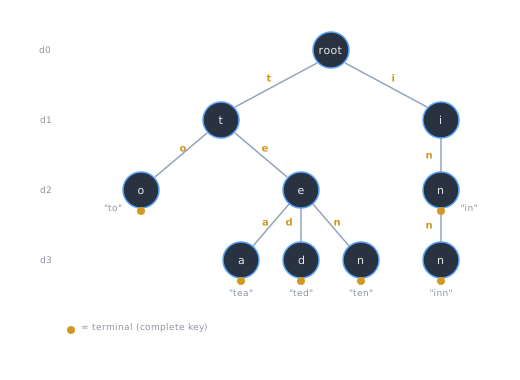
Suppose the set is {to, tea, ted, ten, in, inn} over lowercase letters.
-
Insert
"to": root→t→o(terminal ato). -
Insert
"tea": root→t→e→a(terminal ata). -
Insert
"ted": sharet→e, then edged(terminal atd). -
Insert
"ten": sharet→e, then edgen(terminal atn). -
Insert
"in"and"inn": sharei→n, thennfor"inn".
Now:
-
CONTAINS("te")is false (prefix only, not terminal). -
HAS_PREFIX("te")is true. -
LIST_WITH_PREFIX("te")yields["tea","ted","ten"](lexicographic if child iteration is ordered).
Complexity and Performance
Let L be key length, σ = |Σ| the alphabet size, and n the number of keys.
-
Lookup/Insert/Delete:
Θ(L)expected/worst-case steps (one per character), givenAdj[u]offers near-constant-time child access by symbol (e.g., array or hash map). -
Space: In the worst case,
Θ(total_characters_across_keys)nodes/edges if little prefix sharing. With strong sharing, space can be close to the number of unique prefixes. -
Enumeration by prefix:
Θ(|P| + output)(plus traversal overhead). This is the big advantage over hash tables and many trees.
Constant factors matter:
-
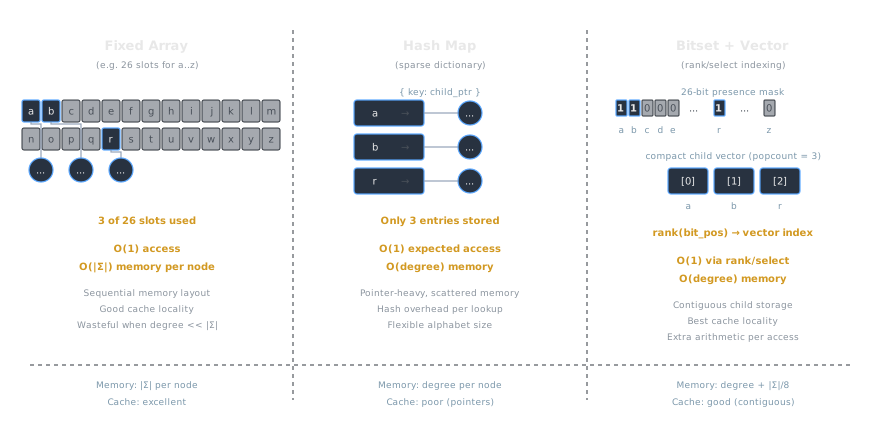
Fixed-size child arrays (
σslots per node) provideO(1)access but inflate memory (Θ(σ·nodes)). -
Sparse maps (hash tables or ordered maps) cut memory when degree is small, at the cost of lookup overhead (hashing or
log dwheredis node degree).
Tip
For byte alphabets (
σ=256), prefer sparse children until node degree grows beyond a threshold, then switch to a dense representation (adaptive nodes).
Implementation Details or Trade-offs
Node representations
-
Dense array (e.g., 26 for lowercase letters)
-
Pros: truly constant-time child access; sequential memory.
-
Cons: wastes space for sparse nodes; large σ (Unicode) makes it impractical.
-
-
Sparse dictionary (hash map)
-
Pros: space proportional to actual degree; flexible alphabet.
-
Cons: hash overhead; iteration order may be arbitrary (sort keys for lexicographic output).
-
-
Ordered map (tree)
-
Pros: natural lexicographic iteration without sorting; predictable iteration order.
-
Cons:
O(log d)child access.
-
-
Bitset + compact vector
-
Pros: a bitset marks present children; an array stores only existing edges; quick rank/select maps char→index.
-
Cons: extra arithmetic per step; more complex code.
-
Memory engineering
-
Pool/arena allocators reduce overhead of many small node allocations and improve locality.
-
Path compression (radix/Patricia tries) merges single-child chains into a single edge with a string label, shrinking depth and memory (see Compressed Trie).
-
DAWG/minimal DFA for static sets deduplicates identical subtries to near-minimal size (advanced; build-time cost).
Values and payloads
-
For map semantics, store
valueat terminals. If values are large, consider indirection (IDs into a side array) to keep nodes small. -
Add
countorsubtreeWeightto support “how many keys start with this prefix?” or top-k completions with heaps.
Unicode & normalization
- Decide whether to iterate by code units, code points, or grapheme clusters. Normalize text (NFC/NFKC) to avoid multiple encodings for the same visible string. See Strings.
Persistence and concurrency
-
Persistent tries (copy-on-write path to leaf) enable snapshots and versioning with structural sharing.
-
Lock-free variants exist using immutable nodes; writers publish new roots, readers see consistent versions.
Note
For static dictionaries (read-mostly), consider building a compressed trie or even a minimal DFA for drastic memory savings with the same prefix capabilities.
Practical Use Cases
-
Autocomplete & prefix search: list completions for a typed prefix; maintain per-node counts for ranking by frequency.
-
Spell checking & approximate match: traverse with edit-distance DP states (Levenshtein automaton + trie).
-
Routing & token dispatch: longest-prefix match on tokens (domain names, URL segments, command parsers).
-
Keyword filters: store blocked terms; early exit on mismatch; linear scan through text with trie-guided branching (Aho–Corasick builds on this idea).
-
Config/key maps where order matters: lexicographic enumeration and range-by-prefix queries integrate naturally.
Limitations / Pitfalls
Warning
Memory blow-up. Naive dense-child nodes multiply memory by
σ. Prefer sparse children, compression, or hybrid nodes.
Warning
Alphabet mismatch. If the runtime stream contains symbols outside
Σ, you need normalization or fallback logic.
Warning
Cache-unfriendly layouts. Pointer-rich structures cause cache misses. Arena allocators and contiguous child storage mitigate this.
Warning
Deletion complexity. Pruning empty tails is simple, but multipurpose counters (
count,terminalCount) must be kept consistent to avoid orphan nodes and incorrect prefix counts.
Warning
Security considerations. Adversarial keys can force long shared prefixes or degenerate shapes; bounding key length and using compression help.
Summary
Tries offer predictable Θ(L) operations and powerful prefix-aware features that hash tables and ordinary trees lack. They shine when keys share prefixes, when you must enumerate by prefix, or when lexicographic order is first-class. The main cost is memory, driven by the alphabet and node representation. With careful engineering—sparse children, path compression, arenas, and appropriate text normalization—tries become a practical and robust foundation for sets and maps of strings.