Overview
Tries come in several practical flavors that address the core trade-off between operation cost in key length and memory footprint:
- Standard trie (explicit-edge): one edge per symbol; depth is the key length; simple and fast but memory-heavy on sparse nodes.
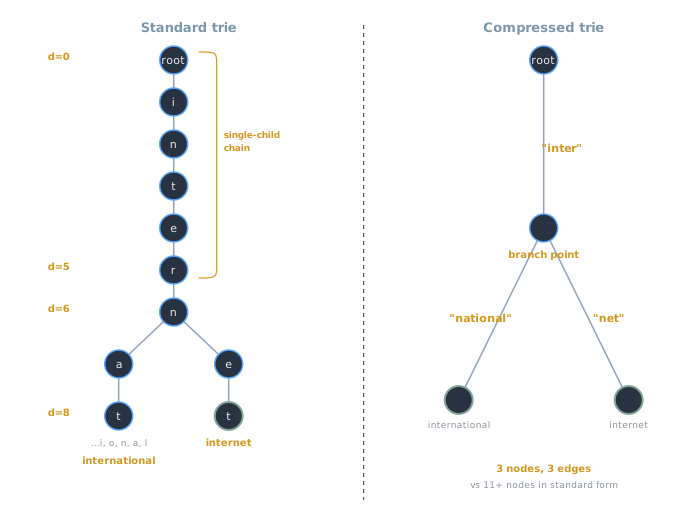
- Compressed (radix/Patricia) trie: merges single-child chains into edge labels (strings), reducing depth and node count while preserving prefix semantics.
- Suffix trie: inserts every suffix of a text; supports substring queries via prefix search on suffixes, at the cost of quadratic space in the worst case.
This note contrasts the three, clarifying when each is appropriate and what invariants must hold to keep operations correct.
Note
Operation costs in tries are typically
Θ(L)whereLis the key length, independent of the number of stored keysn(assuming a bounded alphabet and efficient child lookup). Compressed variants aim to keep the constant factors and depth smaller without changing big-O.
Motivation
- Standard tries shine when keys are short, the alphabet is small, and prefix queries dominate (e.g., command dispatch, small dictionaries).
- Compressed tries mitigate memory blow-ups for long keys with common prefixes (e.g., URLs, filesystem-like paths, language tokens).
- Suffix tries enable fast substring and pattern queries over a single text, useful for pedagogy or tiny inputs, but are usually replaced in practice by suffix trees/arrays due to space.
Definition and Formalism
Let Σ be the alphabet and S a set of keys.
Standard (explicit-edge) trie
- Each edge is labeled by one symbol
c ∈ Σ. - Each node corresponds to a prefix of some key(s).
- A node carries a terminal marker (and optional value) if a key ends at that prefix.
- Depth equals the number of symbols consumed from the root.
Compressed (radix/Patricia) trie
- Any maximal path of nodes with out-degree 1 is contracted into a single edge labeled by a string over
Σ. - Search consumes edge labels possibly partially; if a mismatch occurs in the middle of a label, the key is absent.
- The set of explicit branching points is preserved; depth becomes the number of branching segments, not raw characters.
Suffix trie (of a single text T with sentinel $)
- Insert all suffixes
T[i..]fori=0..|T|. - Any substring
T[i..j]is a prefix of some suffix and thus corresponds to a path from the root. - Worst-case size is
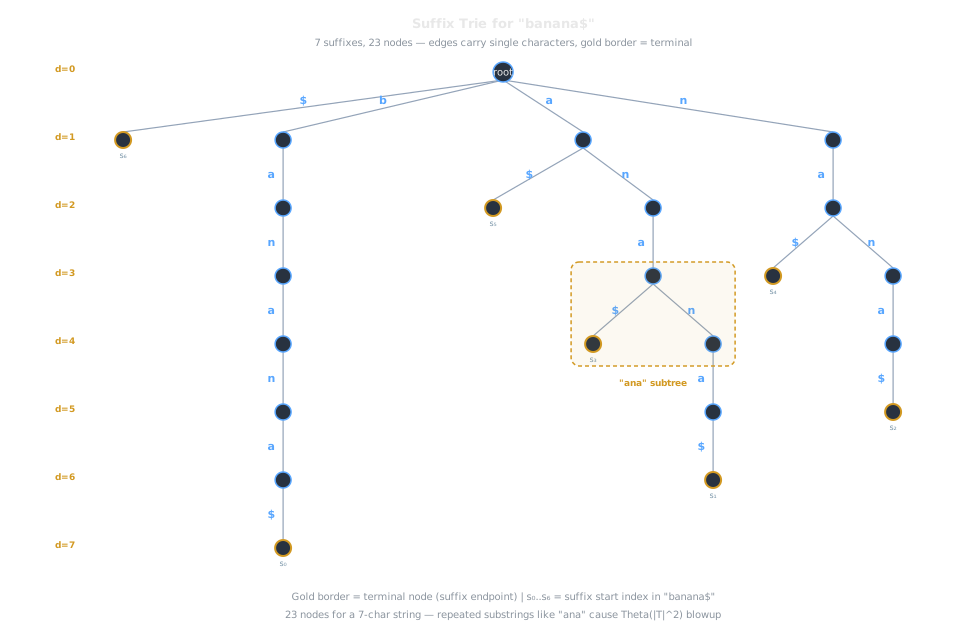
Θ(|T|^2)nodes/edges for large alphabets (many repeated contexts).
Tip
Always append a unique sentinel symbol
$that does not appear inTwhen building suffix variants. It ensures that no suffix is a prefix of another and simplifies terminal handling.
Example or Illustration
Consider keys {to, tea, ted, ten, in, inn} over lowercase ASCII.
- Standard trie: Path labels are single characters: root→
t→ebranches toa/d/n. Depth equals key length (2–3). Node count grows with every new character that diverges. - Compressed trie: The chain
t → e → acan remain separate fromt → e → dby labeling edges"te"then"a"/"d"/"n", or by compressing"to"as a single edge fromt. Node count drops; search compares substrings per edge. - Suffix trie (for
”banana$”): Insert$,a$,na$,ana$,nana$,anana$,banana$. Substring”ana”appears as a path multiple times via different suffix starts.
Properties and Relationships
- Depth and branching:
- Standard depth = key length
L. - Compressed depth = number of branch points on the path; often
≪ Lwith shared prefixes. - Suffix depth can be large due to many starting positions; branching reflects repeated substrings.
- Standard depth = key length
- Space:
- Standard:
Θ(∑ L_i)nodes/edges in the worst case; multiplied by alphabet representation at each node. - Compressed: reduces node count to roughly the number of distinct prefixes/branch points; stores edge labels (substrings) instead of per-character chains.
- Suffix:
Θ(|T|^2)worst-case space; pedagogically clear but impractical at scale.
- Standard:
- Operations:
- Lookup/insert/delete: remain
Θ(L)but compressed tries compare runs of characters (may be faster in practice due to fewer pointer traversals). - Prefix enumeration: identical semantics; compressed tries enumerate by descending through labeled edges, concatenating labels.
- Substring queries: suffix tries support
contains(pattern)inΘ(|pattern|)by routing through the pattern as a prefix of some suffix.
- Lookup/insert/delete: remain
- Alphabet handling: Large
|Σ|magnifies memory in standard tries if nodes use dense arrays; compressed tries still benefit from sparse maps at branch points.
Implementation or Practical Context
Standard trie (explicit-edge)
- Children representations: fixed arrays (fast, memory-heavy), hash maps (space-efficient, unordered), ordered maps (lexicographic iteration).
- Best for: small alphabets, relatively short keys, heavy prefix ops (e.g., command trees, small dictionaries).
- Memory tips: hybrid node types (dense for high degree, sparse for low); arena allocators for locality.
Compressed (radix/Patricia)
- Edge labels: store
(startIndex, length)into a shared string pool rather than copying substrings; keeps memory flat and cache-friendly. - Search routine: compare as many characters as match along the current edge label; if fully matched, continue; if mismatch at position
k, split label into prefix/suffix segments when inserting. - Deletion: may require edge concatenation to restore compression when a node’s degree falls to 1.
- Best for: long keys with shared prefixes (URLs, file paths, tokens), memory-sensitive autocomplete.
Suffix trie
- Construction: naive
O(|T|^2)inserts; spaceΘ(|T|^2). For real systems, prefer suffix trees (compressed suffix tries inΘ(|T|)space) or suffix arrays with LCP. - Use cases: teaching substring search concepts; tiny corpora; quick prototypes when memory is not a concern.
- Caveat: for multi-string dictionaries, suffix tries of each key are rarely wanted; use Standard Trie or Compressed Trie instead.
Note
Compressed tries and suffix trees are conceptually similar: both use edge-label strings and path compression. The difference is what is being indexed (arbitrary key set vs all suffixes of one text) and the associated construction algorithms and space bounds.
Common Misunderstandings
Warning
“Radix tries change big-O of lookup.” No—the big-O in key length remains
Θ(L). They reduce depth and pointer traversals, often improving constants.
Warning
“Suffix tries are practical for large texts.” They are not; space is quadratic in the worst case. Use a suffix tree or suffix array.
Warning
“Compression breaks prefix queries.” Not if implemented correctly. Matching proceeds within edge labels; a split occurs only when inserting mismatching characters.
Warning
“Dense arrays are always faster.” With large alphabets or low branching factors, dense arrays waste memory and degrade cache behavior; hybrid/sparse children often win.
Broader Implications
- Data-engineering fit: Domain-specific normalization (case-folding, tokenization to bytes) shrinks effective
|Σ|, improving both memory and speed for all trie variants. - Persistence and versioning: Path-copying tries (standard or compressed) enable immutable versions with structural sharing—useful for configuration maps and IDE index snapshots.
- Ranking and top-k: Augment nodes with
subtreeWeightor frequency counters to support ranked autocomplete; costs apply equally to standard and compressed structures.
Summary
- Use a Standard Trie for straightforward, prefix-heavy workloads with small alphabets and moderate key lengths.
- Choose a Compressed (Radix/Patricia) Trie when keys are long and share prefixes; expect fewer nodes and traversals while preserving
Θ(L)operations. - Reserve Suffix Tries for educational demos or tiny inputs; at scale, switch to suffix trees/arrays.
The right choice hinges on alphabet size, key length/distribution, memory budget, and query mix (exact, prefix, substring). All retain the trie hallmark: predictable, prefix-aware behavior that general-purpose maps cannot match.